Batteries Are No Longer Just "Backup Power" — They’re an Engine for AI
If you ask 10 people what battery storage does in a data center, 9 will likely say "it provides backup power during outages." But in 2026, that answer is already outdated.
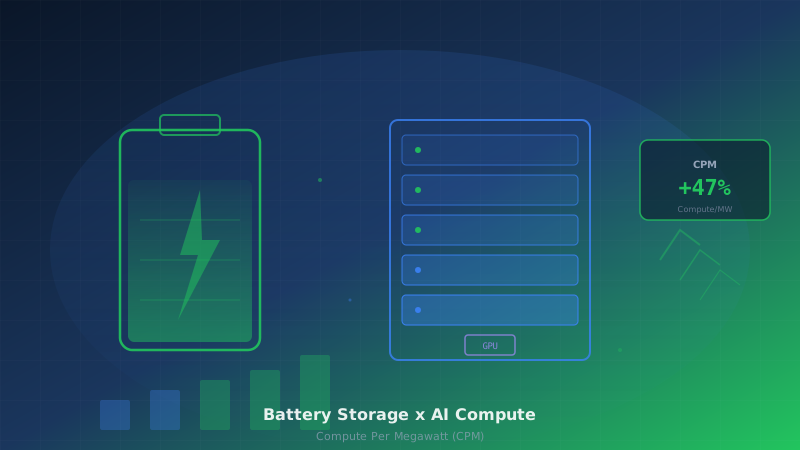
What’s happening now is a major shift in how data centers think about energy. Batteries are being elevated from a "protective device" to an "AI compute enabler" that allows data centers to run more AI workloads than their grid connection would normally permit.
Sounds like magic? Not at all. It’s simply physics — combined with a new way of thinking called "Compute Per Megawatt."
Compute Per Megawatt (CPM) — The Metric Reshaping the Industry
Traditionally, when analysts talked about battery storage for data centers, they viewed it through the lens of electricity pricing: buy power when it’s cheap, store it, use it when prices rise, or sell it back to the grid for profit. That’s the classic energy arbitrage model.
But the new framework known as Compute Per Megawatt (CPM) takes a completely different view.
CPM doesn’t ask, "How much money does the battery save on electricity?" It asks, "How much more AI workload can the battery enable from the same available power?"
That is a dramatic change in perspective.
Why is this so powerful?
Imagine a data center with a 100 MW grid power contract. Under normal circumstances, it can only use 100 MW. But in reality, AI workloads do not consume power at a constant level.
GPU clusters training large models create short bursts of power demand that spike far above the average. Without batteries, the data center must either throttle workloads to stay within contract limits or wait in line for additional grid capacity, which can take years.
With battery storage, however, those power spikes can be absorbed by the battery. From the grid’s point of view, the data center appears to be drawing a stable load within its contracted limit. But in practice, it is running more AI compute than the utility contract alone would allow.
Energy market analyst Alejandro de Diego summed it up clearly: "Storage expands the boundaries of the power budget." In other words, IT-side power management alone cannot fully solve grid constraints. But when combined with batteries, the equation changes.
Behind-the-Meter Batteries — From "Backup Power" to "Compute Enabler"
"Behind-the-Meter" (BTM) refers to batteries installed inside the data center’s own site, not directly connected to the grid for energy trading. Instead, they act as a buffer between the grid and the IT load.
And now, this is becoming a core strategy for hyperscalers worldwide.
The numbers behind the trend
- 30% of planned data centers in the U.S. intend to use behind-the-meter resources as a power source
- Jefferies estimates hyperscalers represent a 20 GW battery storage opportunity by 2035, including roughly 9 GW by 2030
- BloombergNEF has raised its forecast for the U.S. energy storage market to 204 GW by 2035
- The global BESS market is expected to grow from $76.7B in 2025 to $172.2B by 2030
Case Study: Aligned Data Centers
One of the clearest examples is Aligned Data Centers, which announced a 31 MW / 62 MWh battery system paired with a data center in the Pacific Northwest. This system was not designed as backup power, but to bring the data center online years faster than waiting for a traditional utility upgrade.
Duncan Campbell of Scale Microgrids noted that just three years ago, data center developers dismissed onsite power as impractical. Today, many see behind-the-meter energy as essential, not optional.
Co-optimization — When IT Management and Batteries Work Together
What’s especially interesting is that batteries alone are not the full answer, and IT-side power management alone isn’t enough either.
The real value appears when both work together in a model known as co-optimization.
Power Capping + Battery = The secret formula
Here’s how it works:
- On the IT side, processors use power capping techniques to limit peak energy consumption and smooth total load
- On the battery side, the battery absorbs the remaining spikes that power capping cannot handle
- The result? Smaller battery systems become viable, while more aggressive power caps improve efficiency — boosting ROI on both sides
Research shows that data centers using co-optimization can process significantly more AI workload within the same power budget, without requesting additional utility capacity.
That’s why Sean Jones from Tesla Megapack has argued that battery economics continue to improve relative to other options. As gas turbine costs rise and grid interconnection queues get longer, batteries are becoming a highly competitive choice for developers who need power quickly.
MIT’s Thermal Battery — When Energy Storage Lasts 100+ Hours
But the story doesn’t end with lithium-ion.
Professor Asegun Henry of MIT is developing a thermal battery technology that could take the industry a step further through Fourth Power, the company he founded.
How it works
Instead of storing energy chemically like lithium-ion batteries, this technology stores energy as extreme heat using carbon blocks heated to 1,900–2,400 degrees Celsius — nearly half the temperature of the sun’s surface.
The system uses liquid metal to transport heat and thermophotovoltaic cells to convert thermal radiation back into electricity, with conversion efficiency above 40%.
Why does this matter for AI?
What makes thermal batteries different from lithium-ion is duration.
- Typical lithium-ion systems store energy for 2–4 hours
- Fourth Power’s thermal battery can store energy for 10 to 100+ hours
Because the system is modular, customers can scale it as needed. One power block plus one storage block gives about 10 hours of storage. Add more storage blocks, and the system can expand to 20+ hours or more.
Even more impressive, the technology offers energy density of around 100 MW per acre, far higher than most other storage technologies.
In 2023, Arvin Ganesan, former energy executive at Apple, became CEO of Fourth Power — a strong signal that Big Tech is taking this technology seriously.
For data centers running multi-day AI training jobs, a thermal battery capable of 100+ hours of storage could be a game changer, dramatically reducing reliance on the grid during peak demand periods.
The 1 GW Data Center Is Coming — And Batteries Are the Key
By 2026, 1 GW data centers are beginning to emerge — single facilities consuming as much power as an entire industrial city.
These numbers are no joke:
- 1 GW = 1,000 MW — enough to power a medium-sized city in Thailand
- Even a 30–50 MW AI data center is comparable to a major steel plant
- In 2026, global new BESS installations are expected to reach 438 GWh, up 62% from the previous year
Most national grids were not designed to support loads at this scale. Even U.S. power infrastructure has an average age of 50–70 years. Grid expert Clift Pompee notes that much of it was built in the 1950s–1970s, reinforcing the point that battery storage is no longer optional — it is a necessity.
A new metric: "Tokens Per Watt Per Dollar"
Industry analyst Kevin Roof argues that data center success metrics are shifting from "sustainability" to "Tokens Per Watt Per Dollar" — measuring how much AI output is produced for every watt and every dollar spent.
That is the essence of Compute Per Megawatt — and batteries are a critical variable for improving that number without waiting for grid upgrades.
Time-to-Market — Batteries Can Help You "Skip the Line"
One reason battery storage is often overlooked is simple: time.
In many countries, increasing utility capacity or waiting for grid interconnection can take 1–3 years or longer. But installing behind-the-meter batteries can happen far more quickly.
Aligned Data Centers has already shown that battery systems can help facilities begin operations years earlier than waiting for utility upgrades.
For hyperscalers racing to launch AI services, every month behind competitors means lost market share. That makes battery deployment not just an energy strategy, but also a time-to-market strategy.
Matt Barnes of Calibrant Energy reports that demand for BESS to accelerate interconnection has grown exponentially in recent years.
A Warning Sign for the Industry — What If Batteries End Up Selling Arbitrage Instead of Enabling Compute?
Analysts have pointed out an important signal to watch: if hyperscaler batteries ultimately generate revenue from the wholesale power market rather than enabling computation...
"...it means something may be wrong with the compute growth story used to justify the investment."
This is an important litmus test. If batteries are truly being used to enable AI compute, they should generate value per MWh that is far higher than energy arbitrage, because AI compute revenue per MWh can greatly exceed the value of electricity itself.
But if hyperscalers begin selling battery power back to the grid instead, it may suggest that AI compute demand is not as strong as expected — a signal investors and businesses should watch closely.
Implications for Thailand and ASEAN — A Major Opportunity That Requires Preparation
Now let’s bring this back to our region. The numbers tell a very clear story.
Thailand is becoming a data center hub
- Thailand’s data center power market in 2026 is worth around $503 million, and is projected to grow to $814 million by 2031 (CAGR 10.12%)
- AWS, Google, ByteDance, and Microsoft are investing billions of dollars in Thailand’s data center sector
- Thailand’s BOI continues to approve new data center projects at a rapid pace
Thailand’s 10 GW energy storage target
Thailand’s BOI has introduced policies including PUE standards and support for advanced computing to drive integration between data centers, energy storage, and solar PV, with a goal of 10 GW of energy storage by 2037
According to Ember, expanding solar and battery capacity beyond current targets could help Thailand save $1.8 billion in power generation costs between 2026 and 2037
ASEAN is waking up
The ASEAN Smart Energy & Energy Storage Expo (ASEE) 2026, held on March 25–27, 2026 at IMPACT Exhibition Center in Bangkok, featured more than 400 exhibitors from around the world across solar, batteries, power supply systems, and clean energy solutions.
What does all this mean? It means battery storage for data centers is no longer a distant topic for Thailand — it is happening here, now.
Renewable Energy + Battery = The Complete Equation
There is another angle we must consider: renewable energy is growing at 22% per year, and already supplies about 27% of data center electricity. By 2030, it is expected to meet nearly half of growing electricity demand.
But renewable energy has a critical weakness — it is intermittent. When the sun sets, solar output disappears. When the wind stops, wind generation drops.
Battery storage is the bridge that turns renewable power into a reliable energy source for AI workloads that must run 24/7.
For data centers in Thailand facing pressure around ESG and carbon footprint reduction, combining solar + battery storage + a behind-the-meter strategy will be a compelling formula that addresses cost, speed, and sustainability at the same time.
Data Centers Are Shifting from "Consumers" to "Key Players in the Grid"
Grid expert Tom Traugott argues that data centers are changing roles. Instead of being only major electricity consumers, they are becoming active participants in grid stability.
Data centers equipped with battery storage can:
- Provide load flexibility — reducing or increasing grid demand as conditions change
- Provide storage solutions — storing excess energy for peak periods
- Provide onsite generation — reducing grid pressure during critical periods
- Lower costs for other electricity users — through collaborative utility partnerships
This creates a true win-win: data centers gain more computing capacity, the grid becomes more resilient, and other users avoid sharp increases in electricity costs.
Why Should Thai Businesses Care About This Now?
If you’ve read this far, you may be wondering: "What does this have to do with my business?"
The answer is simple: everything.
1. AI costs will be tied to energy strategy
In the near future, the cost of using AI will not be measured only by GPU or software costs. It will be directly tied to access to energy. Businesses that understand energy strategy will have a cost advantage.
2. Choosing the right data center becomes a competitive advantage
Selecting a data center provider with a strong battery strategy means better uptime, lower latency, and more competitive long-term pricing
3. A new supply chain is emerging
Battery storage for data centers is creating opportunities across an entirely new supply chain — from battery manufacturing and installation to maintenance and energy management software
4. ESG and regulatory compliance
Businesses that run cloud and AI workloads from data centers with battery and renewable strategies will have a lower carbon footprint, which is becoming an increasingly important requirement in multinational supply chains
Conclusion — We’re at a Turning Point Where Energy, Not Hardware, Is AI’s Main Constraint
The year 2026 marks the moment when power infrastructure overtakes computing capacity as the main bottleneck to AI expansion.
Battery storage is no longer just an "add-on." It is one of the most critical pieces of infrastructure for AI growth in the coming decade.
Compute Per Megawatt is becoming a metric as important as FLOPS or tokens per second — because no matter how powerful GPUs become, without electricity, they are just metal boxes.
For Thailand and ASEAN, we are at a moment of both opportunity and challenge. Data centers are arriving, investment is flowing, but the question remains: Do we have the energy infrastructure to support them?
Businesses that understand this shift and prepare for it will be the winners in an era where energy is power — both literally and strategically.
Need advice on AI strategy, data center planning, or digital infrastructure for your business? The Enersys team is ready to help you analyze and plan everything from start to finish.
Talk to us →
References
- Why battery storage is becoming the new engine of AI growth — ESS News
- Turning extreme heat into large-scale energy storage — MIT News
- Data centers are beginning to embrace batteries for onsite power — Latitude Media
- 2026 Predictions: AI Sparks Data Center Power Revolution — Data Center Knowledge
- Adding solar and battery capacity can help Thailand save $1.8 billion — Ember
- Rising Data Center and Industrial Park Investments Transform Thailand's Power Needs — ASEE Expo
- The batteries behind AI and U.S. data centers — Battery Council International