TL;DR
On January 12, 2026, Apple and Google issued a joint statement that reshaped voice assistants in a single line — the new Siri runs on a custom 1.2 trillion-parameter Gemini model, and Apple is paying Google roughly $1 billion per year for it.
First reaction for many: "Did Apple just lose?" Read the architecture and the picture flips.
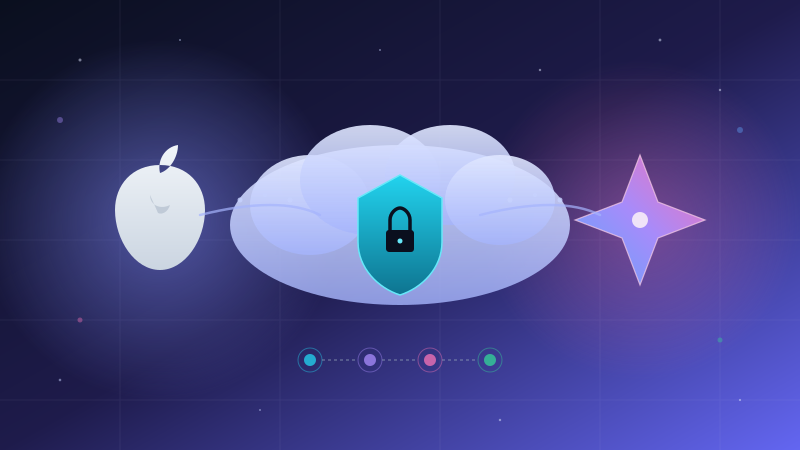
This Gemini variant doesn't run on Google servers. It runs on Apple Private Cloud Compute (PCC) — Apple's own infrastructure. User data is isolated from Google entirely. Google gets paid, Apple gets the model, users get a Siri that finally works — complex task success climbed from 58% to 92% with sub-0.5-second response times.
iOS 26.4 begins rolling out March-April 2026. iOS 27 later in 2026 brings full Siri 2.0 with proactive agentic capabilities.
I'm writing this because the deal isn't just tech news — it's the inflection point for five things Thai businesses need to track: app development, mobile marketing, enterprise BYOD, customer service, and PDPA compliance.
The Moment Apple Admitted It "Lost"
Rewind 14 years. Siri shipped on the iPhone 4S in October 2011 — the first voice assistant in a billion pockets.
What happened next is well-known. Siri became a punchline. iPhone users joked that Siri "doesn't understand anything." Google Assistant pulled ahead. Alexa pulled ahead. ChatGPT voice mode embarrassed both.
WWDC 2024 promised Apple Intelligence and a smarter Siri. Headline features slipped to 2025, then slipped again. By late 2025, internal rumors said Apple's in-house LLM team had hit a ceiling — they couldn't catch Google, OpenAI, or Anthropic on their own.
Then January 12, 2026 happened. Apple stood beside Google and said something the company had never said in 40 years — "We'll use a competitor's AI for our core feature."
This isn't a commodity chip. It isn't a licensed codec. It's the brain of a product Apple sells 20 million units of every month.
If you've followed Apple a long time, you understand how hard that admission is. Tim Cook made the call because it's the right call.
That's why this matters. Apple didn't surrender. Apple admitted reality and engineered a way that still preserves their privacy standard.
The Deal in One Minute
Just the facts:
- Value: Apple pays Google roughly $1 billion/year
- Term: Multi-year
- Model: Custom Gemini at 1.2 trillion parameters — Apple-only, not the public Gemini
- Where it runs: Apple Private Cloud Compute (PCC), not Google Cloud
- Data access: Google has no path to user data the model processes
- Rollout: iOS 26.4 (March-April 2026) for initial features, iOS 27 (late 2026) for full Siri 2.0
- Devices: All Apple Intelligence-compatible iPhone/iPad/Mac
The unique part: Apple structured a deal nobody had done with Google before — buying the "brain" without buying the infrastructure.
Normally, large enterprises using Gemini run it on Google Cloud, with data passing through Google. Apple inverted the equation: the model lives in our house; the data never visits theirs.
Private Cloud Compute — What Makes This Deal Special
3-tier processing
The new Siri decides what kind of "brain" each request needs and routes accordingly:
Tier 1 — On-device
Simple requests: "Set a 5-minute timer." "Play this song." "Text Mom." Processed entirely on-device. No internet. Fast, battery-friendly, maximally private.
Tier 2 — Apple Private Cloud Compute
Context-heavy requests: "Summarize the last 5 emails from my manager." "Find the photos from Chiang Mai last year." Sent to PCC running on Apple silicon servers in Apple data centers. Encrypted, stateless, no session retention.
Tier 3 — Custom Gemini via PCC
Truly complex requests: "Draft a proposal for project X using my last three meeting notes and compare it to the competitor I logged in Notes." Routed to Gemini 1.2T — but the Gemini sits on Apple PCC servers, not Google's.
Privacy Architecture
The interesting design choice: Apple put a "privacy buffer layer" in front of Gemini.
- Stateless compute nodes — PCC processes and discards. No session retention. No logs that link back to a user.
- Anonymization layer — Before reaching Gemini, payloads are stripped of identifiers — Apple ID, device ID, over-precise location.
- No training — The contract explicitly bars Google from using Apple user data to train the model.
- Verifiable — Apple has open-sourced parts of PCC for security researchers to audit (the "verifiable privacy" claim).
In plain terms: Google gets roughly $83M/month in licensing revenue, while gaining nothing from users — no queries, no behavior, no fresh training data.
For Google it's pure licensing income. For Apple it's buying capability while keeping the privacy brand intact.
Why Apple Picked Google, Not OpenAI or Anthropic
The natural question — why not Claude (the safest in researchers' eyes) or GPT-5 (the strongest)?
Three likely reasons:
1. Gemini family covers the full stack
Google ships Gemini Flash (small, fast), Gemini Pro (mid), Gemini Ultra/1.2T (top end). Apple needed full coverage to map onto its 3-tier PCC architecture.
2. Google accepted the isolation terms
Running on Apple hardware, no data flowing to Google, no training on Apple users — OpenAI might not have accepted this. Anthropic is too small to staff it. Google said yes because of money ($1B) and because they didn't want to risk the existing Safari search deal worth $20B+/year.
3. Chrome and Search data are the hidden card
There's speculation Apple granted Google expanded access to anonymized signals from Maps/Safari as part of the deal — but Apple hasn't confirmed this directly.
Net: Google was the only player "big enough" and "flexible enough" to accept a deal where Apple controls the architecture end-to-end.
Performance: 58% → 92%
In press briefings Apple claimed complex multi-step task success climbed from 58% to 92% — that's a massive jump.
What's a "complex multi-step task"? Things like:
- "Check next Saturday's calendar, find a 2-hour slot, and send Dad an invite to dinner at the place he likes."
- "Summarize today's emails about Project Alpha and create Reminders sorted by priority."
- "Pick the 5 best photos I took yesterday, write captions, and post to Instagram."
Old Siri handled one step. New Siri nails 9 out of 10.
Sub-0.5-second response time
This is what makes Siri competitive with ChatGPT voice — ChatGPT voice responds around 320ms, new Siri under 500ms. Slightly slower, but close, with the structural advantage of being native and not requiring an app launch.
Screen Awareness
The biggest new Siri feature: it can read your screen — see what you see and act on it. Reading an email, you say "add to calendar," and Siri creates the event from the email content. No typing.
For everyday users this is a quality leap. For developers, it's a paradigm shift — your app becomes a surface that AI can read.
Business Impact — Five Dimensions
1. App Developers
If you ship an iOS app, your mental model needs to shift. From "users open my app" to "how will Siri use my app on behalf of the user."
App Intents API becomes the primary entry point. Instead of UI screens, the new Siri calls your App Intents — and the user might never open the app at all.
If your app doesn't expose App Intents, Siri can't find you, and users go to whoever does.
Concrete example: User says "Book a table at Blue Elephant tomorrow at 8pm." Siri checks which on-device apps expose a BookReservation intent. You have one → Siri calls it directly. You don't → Siri opens a web browser and routes to your competitor.
This is App Store Discovery v2. The question isn't "Am I in the top charts?" anymore. It's "Does Siri know what my app can do?"
2. Mobile Marketing
Voice search by Apple users will now beat web search to the punch — it's faster, simpler, doesn't require pulling the phone out.
The word SEO needs reinterpretation. Search Engine Optimization becomes Voice/Agent Optimization:
- Your brand needs clean structured data (schema.org)
- Hours, prices, locations must be machine-readable
- Reviews matter more (AI summarizes 100 reviews into a recommendation)
- Being "mentioned" in an AI response matters more than ranking on a search results page
If you run e-commerce, local services, or restaurants, audit this: when a user asks Siri "best coffee shop near me," where does Siri pull your info from? No data → no recommendation.
3. Enterprise Mobile and BYOD
The thing Thai CIOs should worry about most — employees will use Siri to do company work.
Concrete scenario:
- A sales rep tells Siri: "Summarize all emails from customer ABC this month and send to my manager."
- Siri reads work email → processes at PCC → may reach Gemini → returns summary.
Compliance questions:
- Does work email reach Apple servers? (Yes, via PCC, even if encrypted.)
- Does Thai customer data (PDPA) leave the country? (Possibly, to a US data center.)
- What consent did the company collect before employees started doing this?
PDPA implications:
Under Thailand's PDPA, sending personal data abroad for processing requires a clear legal basis — standard contractual clauses or an adequacy decision.
If employees use Siri to handle customer data, the company must answer:
- Is there a Data Processing Agreement with Apple?
- Is Apple PCC under GDPR/PDPA jurisdiction?
- Are there audit logs?
MDM policy needs updating:
If you run Mobile Device Management (Jamf, Intune), make a decision:
- Disable Siri for managed apps entirely?
- Enable selective features only?
- Whitelist by data classification?
This is a policy decision to make before iOS 26.4 lands at scale, not after.
4. Customer Service
Customer behavior is about to shift. Instead of opening your website to find a call center number, customers will just ask Siri.
"Siri, give me the call center number for Bank X."
"Siri, summarize Brand Y's return policy."
"Siri, book a service appointment at Dealer Z tomorrow morning."
If your data:
- Isn't in schema.org
- Has no structured FAQ
- Has no public API an AI can call
→ Customers either get nothing or get the wrong answer.
What to do:
- Audit structured data on your corporate site
- Add FAQPage, LocalBusiness, Organization schemas
- Consider a read-only API for non-sensitive info (store hours, product specs, service availability)
5. Privacy and Compliance — Apple PCC as the New Benchmark
Strategically important — Apple PCC is becoming the benchmark enterprises use to pressure other vendors.
CIOs will start asking Microsoft, Google, Salesforce, ServiceNow:
- "Can you process data statelessly?"
- "Will you open-source your security layer for audit?"
- "Will you guarantee no training on customer data?"
Microsoft Copilot is already adapting — announcing "Copilot Pro Enterprise" with stateless claims similar to PCC.
Google Cloud AI is rolling out "Confidential AI" using Intel SGX and Nvidia H100 TEE.
For Thailand: by 2027 I expect Thailand's PDPC (Personal Data Protection Committee) to start citing PCC-style architecture as a best practice for AI processing of personal data.
Whoever aligns with this architecture pattern early will have an edge when regulation tightens.
18-Month Predictions
Five bets I'd make for the next 18 months:
1. Android counter-attacks with Pixel 11 + Gemini Nano 2
Google can't let Apple own the narrative that "Apple does Gemini better than Google." Pixel 11 in late 2026 will likely ship comparable on-device Gemini plus a privacy story that borrows from Apple PCC.
2. Microsoft Copilot for iPhone
Microsoft will push hard to make Copilot an alternative voice assistant on iPhone — if Apple opens the API, Microsoft will make Copilot the default for enterprise accounts.
3. App Store changes
Apps without Siri integration (App Intents) will be deprioritized in search results. Apple won't say it directly, but the ranking algorithm will shift.
4. Voice commerce becomes real
For iPhone users, ordering through Siri will become normal early-adopter behavior. By 2027, big Thai retailers (Central, Shopee, Lazada) will likely have Siri integration.
5. Enterprise voice security policy reaches maturity
Large organizations will have separate voice AI data policies distinct from mobile policy. Rules about "what you can say to AI" will be as strict as email policies.
Watchouts
For Organizations (do within 60 days)
- Audit BYOD fleet: How many employees use iPhones eligible for iOS 26.4? New Siri is enabled by default.
- Update Acceptable Use Policy: Specify what data types can never be spoken to a voice assistant (customer PII, financial data, trade secrets).
- Refresh PDPA documentation: Data flow diagrams must include voice assistant as a data processor.
- MDM rules: Consider disabling Siri inside managed apps that handle sensitive data.
- Employee training: 80% of users don't know where Siri sends their data. Train them.
For Developers
- App Intents audit: Which intents does your app expose? Do they cover the main use cases?
- Performance budget: iOS 27 Siri will call your app's APIs in the background more often — rate limits, caching, error handling all matter more.
- Semantic data: Tag in-app structured data (Core Data, SwiftData) so Siri understands context.
- Privacy labels: App Store privacy labels need re-declaration if you add Siri integration that processes data.
For Marketers
- Brand voice audit: How does Siri/AI summarize your brand? Try asking Siri now.
- Review strategy: AI weighs reviews in aggregate, so detailed + positive + recent reviews matter most.
- Structured data everywhere: schema.org on every product/service/location page.
- Public Q&A content: Phrase FAQs the way someone asks Siri — natural language, not keywords.
What This Means for Enersys
What our team has been doing with clients since the deal was announced:
1. Mobile-first apps must consider voice from day one
Every new project with an iOS component now includes a Siri integration discussion in the discovery phase — not as an afterthought.
2. PDPA assessments must include voice data flow
When we run DPIA (Data Protection Impact Assessment) for clients, we now add a section on voice assistant data flow. It's the data processor everyone forgets.
3. Odoo customer portals = voice-ready
For Enersys clients running Odoo with customer portals, we're mapping a 12-month roadmap: portals need complete structured data so voice assistants can reach them. Our clients' customers will ask Siri before opening any portal.
4. Privacy architecture advisory
For large enterprise clients asking "how should we handle AI data privacy," we're now recommending PCC-style patterns — stateless processing, encryption in use, audit trails.
We don't share specific implementation details — those are competitive edge — but the principle is clear: AI doesn't mean trading away privacy. Apple just showed the world you can have both.
Closing Thoughts
The Apple-Google $1B deal looks like routine business news. It isn't. It's the blueprint for the next era of enterprise AI — the era where you can buy the "brain" without surrendering the "data."
For Thai businesses, three takeaways I want to leave you with:
1. Architecture matters more than model
Which AI model is "best" matters less than how you deploy it. Apple PCC will be the case study cited in every major RFP through 2027.
2. Voice is the new UI — like it or not
Within 18 months, iPhone user behavior will shift. Without a plan, you'll disappear from the consideration set.
3. PDPA just got a new layer
Voice assistants are the data processor everyone forgets in DPIAs. Updating documentation now is cheaper than getting fined next year.
Five years from now, I think we'll look back at January 12, 2026 as the day "AI + Privacy" started being designed as partners, not trade-offs.
That's the best news there is for any business serious about data.
Sources