3x Faster, but Breaking Things Twice as Often
Imagine you own a sports car that can hit 300 km/h — but the road ahead is gravel, with no guardrails, no traffic lights, and no repair shop in sight.
That’s what software development looks like in 2026. AI coding tools let teams write code faster than ever before, but the systems behind the scenes — CI/CD pipelines, testing, monitoring, and deployment — often haven’t been upgraded to handle that speed.
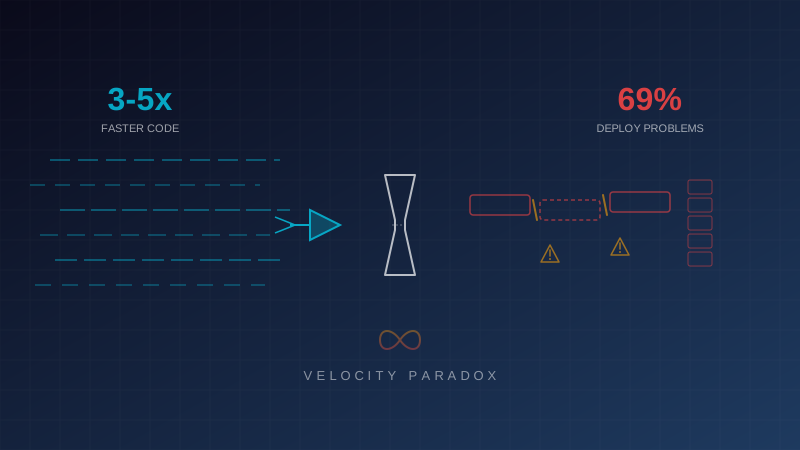
This is what people are calling the “AI Velocity Paradox”: the faster you write code, the more problems you create downstream.
The Numbers That Should Make You Pause — Harness Report 2026
Harness’s “State of DevOps Modernization 2026” surveyed 700 engineering professionals across five countries — the United States, the United Kingdom, Germany, France, and India — in February 2026, and the findings are hard to ignore.
Developers who use AI coding heavily (multiple times per day):
| Metric |
Heavy AI Use |
Some AI Use |
| Deploy daily or more often |
45% |
15% |
| Frequent deployment issues |
69% |
Much lower |
| Average incident resolution time |
7.6 hrs |
6.3 hrs |
| Increase in manual QA work |
47% |
28% |
| After-hours work due to release problems |
96% |
66% |
Take a close look at that.
The teams using AI most aggressively to write code are also the ones facing the most severe problems, spending the most time fixing them, and working the most overtime.
This isn’t random — it’s a structural paradox.
Why Does More Speed Create More Failure? — The Root Causes
1. Pipelines were never designed for 3–5x more code throughput
When AI helps developers write code 3–5 times faster, the number of pull requests, builds, and tests grows with it. But CI/CD pipelines built for yesterday’s throughput quickly become bottlenecks.
Harness found that 77% of teams still have to wait on other teams for delivery work that should already be automated, and only 21% can create a production-ready pipeline in under two hours.
2. There is no real “golden path” — every team builds its own
73% of respondents said that few, if any, teams in their organization use standard service or pipeline templates — a true “golden path” barely exists.
The result? Every team reinvents everything from deployment and testing to rollback procedures. Nothing is repeatable, nothing is easy to maintain, and when something goes wrong, there’s no shared playbook to follow.
3. AI generates code quickly, but it doesn’t generate understanding
This is the deepest issue.
When developers accept AI-generated code without reviewing it carefully, that code may appear to work at first — but it can still:
- Clash with the system’s overall architecture
- Miss important edge cases
- Introduce unnecessary dependencies
- Create hidden security vulnerabilities
In the same Harness report, 51% of heavy AI-coding teams reported code quality issues, and 53% reported an increase in security vulnerabilities.
The Rise of “Vibe Coding” — Writing by Vibe, Deploying by Karma
The term “vibe coding” has become a major talking point in the developer world. It describes a workflow where developers explain what they want in natural language, AI generates the code, and the developer mainly decides whether to accept it.
It sounds great — until it hits production.
What works locally does not automatically work in production. Authentication may fail, APIs that seemed available may disappear, and setups that looked clean on a developer machine can turn into error-filled server logs the moment they go live.
The New Stack reported that many software experts warn 2026 could be the year we see a “major blowup” from vibe-coded applications reaching production without enough validation.
Troubling quality signals
Research on code quality suggests that:
- AI-generated code causes 1.7 times more issues per pull request than human-written code
- Teams using AI without quality guardrails see bug density rise by 35–40% within six months
- 75% of technology leaders expect moderate to severe technical debt from AI adoption
“AI Brain Fry” — A New Kind of Burnout from Constantly Reviewing AI Output
In March 2026, Harvard Business Review highlighted a phenomenon called “AI Brain Fry” — a form of mental fatigue caused by continuously checking AI-generated results.
People experiencing it reported symptoms such as:
- Feeling mentally foggy after reviewing AI-generated code all day
- Slower decision-making and more frequent mistakes
- Difficulty focusing, even on tasks that used to feel automatic
About 14% of respondents reported cognitive fatigue from AI use, and 46.4% expected burnout rates to rise.
What’s notable is this: burnout doesn’t come from having AI write code. It comes from the nonstop effort required to inspect, review, and correct AI output — and from dealing with the problems created by code that never received thorough review in the first place.
Developers Spend 36% of Their Time on Manual Work They Shouldn’t Be Doing
Harness also found that developers spend an average of 36% of their working time on repetitive manual tasks such as:
- Copy-pasting configuration across systems
- Waiting for approvals from people who are too busy
- Rerunning failed jobs caused by unstable infrastructure
- Following up on tickets stuck in the system
When AI makes coding faster but everything after coding is still manual, the result is predictable: the deployment backlog grows even faster, and developers have to work even harder just to push code out the door.
It’s like upgrading a factory so the machines produce goods three times faster while leaving the conveyor belt exactly the same — everything just piles up at the front.
What Does This Mean for Thai Dev Teams?
If you think this is only a problem for large foreign companies, think again.
Development teams in Thailand may face an even tougher version of the problem because of several local constraints.
Common limitations
- Smaller teams, same expectations — Many organizations have dev teams of just 3–5 people, but still expect output comparable to a 20-person team, now with AI in the mix.
- Experienced DevOps engineers are hard to find — Thailand’s talent market still lacks enough seasoned DevOps professionals, so many teams expect one developer to handle both coding and operations.
- A “ship it first, worry about quality later” culture — Time pressure leads many teams to skip testing and review just to hit deadlines.
- Infrastructure isn’t ready — Many organizations still rely on manual deployment or “good enough” CI/CD setups that were never designed for high throughput.
What happens if teams don’t adapt
- Incidents will become more frequent and more severe — Faster code entering production without proper filters will create more complex failures.
- Developers will burn out — Overtime to fix release problems will become normal. (And 96% of heavy AI users are already working after hours.)
- Technical debt will pile up until it becomes unmanageable — Code that no one truly understands will turn into a growing liability.
- Top talent will leave — Good developers do not want to spend their careers firefighting nonstop.
The Way Forward — Balance Speed with Stability
The good news is that this problem is solvable.
But it starts with accepting a simple truth: having AI write code is not the whole answer. You need to build roads strong enough for fast cars.
4 practical principles from the Harness report
1. Create a shared golden path for every team
Establish standard templates for services and pipelines so teams start from a proven foundation instead of reinventing everything each time. This reduces setup time, lowers the risk of mistakes, and makes systems easier for others to maintain.
2. Move quality gates earlier in the process
Don’t wait until staging or production to catch bugs. Shift quality and security checks to the earliest stages of the pipeline so issues are detected while they’re still cheap to fix.
3. Use progressive rollout to reduce risk
Instead of deploying everything at once, use feature flags and progressive rollout techniques to release gradually to real users. If something goes wrong, you can roll back quickly without affecting the whole system.
4. Measure and close the feedback loop continuously
Build clear measurement systems — not just for “how often do we deploy?” but also for “how often do deployments fail?”, “how quickly do we recover?”, and “how healthy and productive is the team?”
Enersys’s Perspective — What We See in Real Projects
From Enersys’s experience building systems for Thai organizations, we’ve been seeing this pattern more clearly every month.
Many clients come to us after saying, “We finished coding really fast” — but then they either can’t deploy, or they deploy and things break.
Here’s what we consistently see:
- Organizations that invest in DevOps first and increase coding speed afterward have significantly fewer incidents
- Teams with strong automated testing coverage can take fuller advantage of AI coding without sharply increasing risk
- Investment in monitoring and observability helps teams catch issues before they affect real users
- Developers who understand the underlying principles — not just the tools — can use AI effectively without creating technical debt
AI coding is a powerful tool — but power without direction becomes a liability.
Conclusion — 3 Questions Every Team Should Ask Today
Before pushing AI coding into overdrive, ask your team these three questions:
Can our pipeline handle it? — If developers start producing code three times faster, can the pipeline absorb that throughput, or will it become the bottleneck?
Is our testing good enough? — Do we have enough automated test coverage to catch issues from faster code generation, or are we still relying on manual testing that can’t keep up?
Is the team ready to respond? — Do we have a clear incident response process, or do we still handle failures with a “whoever is free can go check” approach?
If your answer to any of these is “I’m not sure,” then you’re driving fast on a road that isn’t ready.
Ready to Balance Speed and Stability?
The Enersys team helps Thai organizations build strong DevOps foundations that can safely support AI coding — from pipeline design and automated testing to monitoring and incident response.
Talk to the Enersys team for free — we’re happy to assess your DevOps readiness and help you plan growth without unnecessary risk.
References