The battleground has changed — from AI software to AI infrastructure
In 2024, the AI race was about "who could use AI more intelligently." By 2026, the battleground has changed. The more important question is now: "Who has the infrastructure ready to run AI at production scale?"
No matter how powerful an AI model is, without nearby data centers, clean data, and systems that can support it, AI remains little more than a lab experiment.
A major new wave of AI infrastructure investment across ASEAN
Google Cloud launches Bangkok Cloud Region
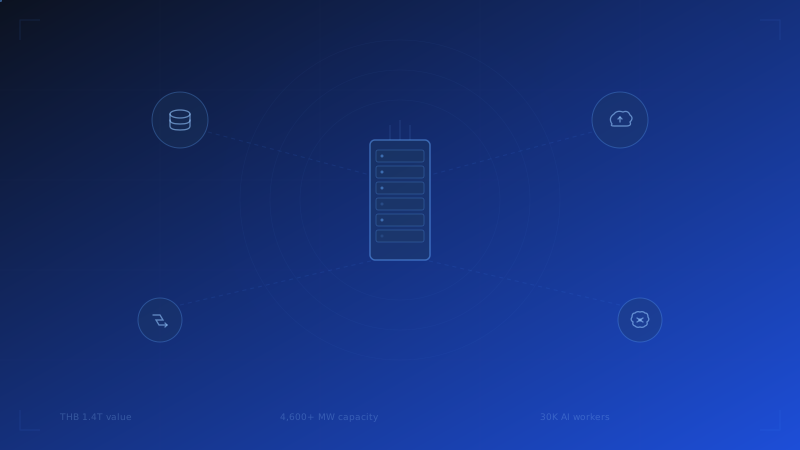
In January 2026, Google Cloud officially launched the Bangkok Cloud Region. It is expected to generate as much as THB 1.4 trillion in economic value for Thailand over the next five years.
One especially strong signal from the Thai developer community came from the ChaiyoGCP program, where more than 110,000 people participated in Training Labs, with 70% focused on AI-related labs — a clear reflection of Thailand’s growing appetite for AI learning.
A regional surge in data center investment
ASEAN is now seeing the largest wave of data center investment in its history:
- More than 4,600 MW of new capacity is being built across the region (an increase of 180%)
- AWS, Microsoft Azure, and Google Cloud are all accelerating Cloud Region launches across ASEAN
- Thailand’s BOI has approved new data center projects worth a combined THB 100 billion
- Spending on AI-optimized servers has risen 38% year over year
But infrastructure alone is not enough — the real issue is the Data Foundation
Analysis from Databricks in March 2026 highlights the real challenge: most organizations in ASEAN still lack a Data Foundation that is ready for AI.
What is a Data Foundation?
A Data Foundation is the core layer an organization needs before it can use AI effectively. It includes:
- Data Quality — clean, accurate, and complete data
- Data Integration — connected data across all systems
- Data Governance — clear rules for who can access what data
- Data Pipeline — automated and reliable systems for moving data
- Data Literacy — people across the organization who understand and can use data
Common issues faced by Thai organizations
Based on regional experience, the most common problems include:
- Fragmented data — each department stores data in its own system with no connection to others
- Data silos — customer data lives in CRM, sales data in ERP, behavioral data on the website, but there is no unified view
- Low data quality — duplicate, outdated, or incomplete data causes AI to learn from the wrong signals
- Talent shortages — Thailand’s data talent market remains severely constrained
Thailand’s digital economy — encouraging numbers
Despite the challenges, the overall outlook for Thailand’s digital economy remains positive:
- Thailand’s digital economy is projected to grow 4.2% in 2026 — twice the pace of the country’s GDP
- The digital economy is expected to reach THB 5.6 trillion
- The government has allocated THB 1.5 billion for AI programs, with a target of developing 30,000 AI professionals by 2027
- IT spending in Thailand is projected to reach THB 1.1 trillion in 2026