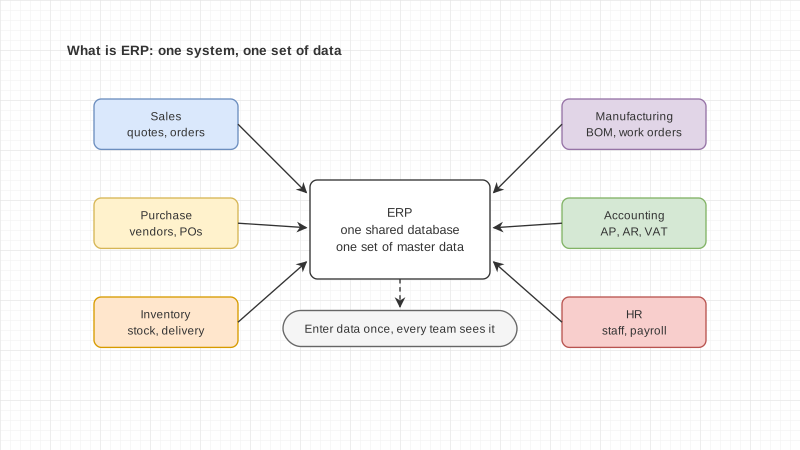
If you are already using an ERP system—whether Odoo, SAP, Oracle, or another platform—you have probably felt that ERP does an excellent job of organizing data, but you still need to ask the right questions to get the answers you want. You need to know which report to run, how to filter it, and how to interpret the numbers yourself.
Now imagine your ERP telling you proactively which products are about to go out of stock, which customers are likely to churn, and which suppliers tend to deliver late this quarter. That is what AI-powered ERP looks like.
The limitations of traditional ERP
ERP systems were designed to record, store, and process business transactions. They excel at consolidating data from multiple departments into one place, allowing everyone to work from the same source of truth. But traditional ERP systems still have several clear limitations.
First, ERP can usually tell you only about the past—not the future. A traditional ERP report can show “how much was sold last month,” but it cannot tell you “how much is likely to be sold next month.” Forecasting still has to be done separately in Excel or a BI tool.
Another common challenge is that ERP contains a massive amount of data, but turning that data into insight still depends on people with expertise. Many reports are generated every month, yet no one reads them because they do not know where to begin the analysis.
Workflow is another issue. Most ERP workflow rules are fixed If-Then logic. They cannot adapt to changing conditions. For example, if approvals normally take two days but a request is urgent, the system still follows the same predefined flow.
Finally, even though ERP is digital, a large amount of information still has to be entered manually—whether creating purchase orders, recording invoices, or updating statuses.
How AI transforms ERP — 5 key dimensions
Predictive Analytics — from historical reporting to future forecasting
This is where AI most visibly changes ERP. Instead of simply saying, “Sales last month were THB 5 million,” the system can say, “Sales next month are projected at THB 4.2 million due to a 15% decline in advance order trends.”
Real-world use cases include:
- Sales forecasting — analyze patterns from historical data, seasonality, and external factors to forecast revenue in advance
- Inventory management — predict which products will run out and when, recommend reorder quantities, and identify the best time to replenish
- Cash flow forecasting — analyze each customer’s payment behavior to improve cash flow accuracy
Intelligent Automation — workflows that can think
AI makes ERP workflows smarter. Instead of simply following fixed rules, they can adapt to context. Imagine scenarios like these:
The accounting team previously had to match every invoice to a PO manually. Now AI reads incoming invoices, matches them automatically with the PO and GRN, and even when the figures are not a 100% match, it can flag the discrepancy and recommend how to handle it.
Approvals are another example. The system learns which types of requests are typically approved immediately and which require detailed review, then prioritizes them for approvers.
Most importantly, AI can detect unusual entries before they are posted—such as abnormally high product prices, unusually large order quantities, or transactions booked to the wrong account category.
Natural Language Interface — talk to your ERP like you talk to a person
Instead of having to learn where reports are located or how to apply filters, AI lets you “ask” your ERP as if you were speaking to a person.
“How do this month’s sales compare with last month?”
“Which customers have overdue payments older than 90 days?”
“Which products are selling best in Northeast Thailand?”
AI converts these questions into queries, retrieves the data from the ERP, and responds in an easy-to-understand format—complete with charts and supporting details. You no longer need to be a power user or an Excel expert to access meaningful business insights.
Anomaly Detection — identify problems before they become major issues
In organizations where data flows into ERP every day, it is impossible for people to inspect every transaction manually. AI acts as a monitoring layer and detects anomalies instantly.
For example, if freight costs increase by 300% this month without any increase in order volume, the system can alert the team immediately. A supplier whose delivery performance is gradually slipping can be tracked before it impacts production. Suspicious patterns that may indicate fraud—such as backdated price edits or duplicate tax invoice issuance—can also be detected.
Smart Reporting — reports that tell a story
This is a dimension many organizations overlook. Instead of receiving tables of numbers that still need interpretation, AI can generate reports with narrative context. For example:
“Revenue this quarter declined by 8% compared with the previous quarter. The main reason was reduced order volume from three customers: [name]. They should be contacted to understand the cause.”
“Raw material costs increased by 12%, while selling prices have not yet been adjusted, resulting in gross margin declining from 35% to 28%.”
“There are 23 invoices due this week with a total value of THB 2.8 million. It is recommended to follow up with the 5 customers who have a history of late payment.”
Case study: AI + Odoo in Thai enterprises
As an Odoo Silver Partner, Enersys has direct experience integrating AI into Odoo ERP systems for clients across a wide range of industries.
One retail company connected AI to Odoo Inventory to predict upcoming stockouts. Previously, the team had to perform a manual review every week. Now the system provides alerts two weeks in advance, reducing stockout issues by around 40%.
Another client, a manufacturing company, used AI to analyze data from Odoo Manufacturing to identify patterns that caused waste. As a result, it reduced its defect rate by 25% within six months.
A service company, meanwhile, implemented AI to read vendor invoices and automatically record them in Odoo Accounting. The accounting team reduced the time spent on this task by nearly 60%.
How to start integrating AI into ERP
For organizations already using ERP and looking to add AI capabilities, here is the recommended approach.
Start with a clearly defined problem. Do not try to add AI to every part of the ERP at once. Choose the single pain point that matters most—such as inventory management, reporting, or data entry—and begin there.
One of the biggest advantages of already having an ERP system is that you already have accumulated data ready for AI. There is no need to collect entirely new datasets. AI can start learning from the data you already have.
From a technical perspective, there is also no need to replace the entire ERP system. Many AI solutions can connect to ERP via APIs without requiring changes to the existing core system.
Once you begin, define clear KPIs and measure outcomes consistently. If the results are strong, you can expand AI into other parts of the ERP environment.
Summary
ERP remains the backbone of enterprise management. But in an era where data is growing every day and competition is becoming more intense, an ERP system that only records data is no longer enough. AI is what transforms ERP from a system of record into a system that helps think, helps decide, and helps act.
Organizations that integrate AI into ERP earlier will gain a clear advantage in cost, speed, and decision quality.