When “Developer Tools” Are No Longer Just Text Editors
If you still picture software developers typing code line by line, that image is already outdated.
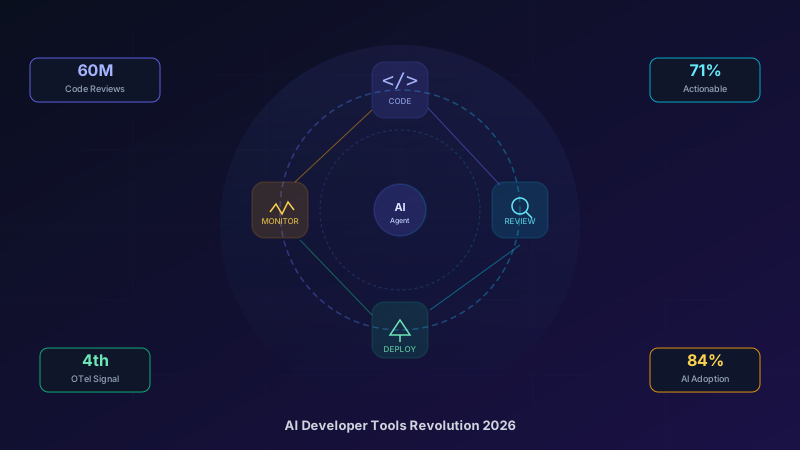
The first quarter of 2026 has reshaped software development in ways we have never seen before. GitHub announced that Copilot has already completed 60 million code reviews. OpenTelemetry introduced Profiles as the fourth signal of observability. And 84% of developers worldwide now use AI tools in their day-to-day work.
What is happening is not just “AI helping write code.” It is a full-scale transformation of every stage of the software development lifecycle — from planning, coding, reviewing, and testing to monitoring in production.
In this article, we’ll look at the big picture behind these changes and explore what they mean for software development teams in Thailand.
Copilot Code Review: From Zero to 60 Million Reviews — Why This Number Matters
10x Growth That Changes the Game
In April 2025, GitHub launched Copilot code review as an experimental feature. Less than a year later, that number has surged to 60 million reviews — a 10x increase — and now accounts for 1 in every 5 code reviews on GitHub.
But the more interesting story is not the volume. It is the quality.
71% Actionable — Silence Is Better Than Noise
What makes Copilot code review different from traditional linters or static analysis tools is that it knows when to stay quiet.
- 71% of reviews provide feedback developers can actually act on
- For the remaining 29%, the system chooses not to comment rather than add noise
- An average of 5.1 comments per review — enough to be useful, not enough to be annoying
That philosophy — “Silence is better than noise” — is exactly why developers are willing to embrace it. No one wants a bot that comments on every line for no real reason.
Agentic Architecture — Not Just Looking at Code, But Understanding Context
Since March 5, 2026, GitHub has moved Copilot code review to an agentic architecture, which means:
- The system pulls context from the entire repository before giving feedback — not just the diff
- It checks whether changes align with the project’s architecture
- If it finds an issue, it can automatically generate a fix PR through its coding agent
The result? Developer satisfaction increased by 8.1% after the shift to agentic architecture, and more than 12,000 organizations have configured it to run automatically on every pull request.
One case study from global fintech company WEX showed that after expanding Copilot usage, teams were able to ship around 30% more code without sacrificing quality.
Copilot CLI: When the Terminal Becomes an “Agentic Development Environment”
From Preview to GA
On February 25, 2026, GitHub officially announced that Copilot CLI had reached General Availability. What started as a preview in September 2025 has now evolved from a simple terminal helper into a full-fledged agentic development environment.
Not Just Autocomplete — But an Agent That Can Think
What sets Copilot CLI apart from a typical AI coding assistant is how it operates:
- Plan Mode — analyzes the request, asks follow-up questions, creates a plan before taking action, and keeps the developer in control
- Autopilot Mode — works autonomously from start to finish, running commands, testing, and applying fixes without waiting for approval
It also includes specialized agents that are triggered automatically depending on the situation — for codebase analysis, build and test execution, code review, and implementation planning.
Why This Matters for Thai Development Teams
When coding agents can work from the terminal all the way into the CI/CD pipeline, it means:
- Less context switching — no need to jump constantly between the IDE, browser, and terminal
- Automation of repetitive work — simple bug fixes, test generation, and documentation can be handled automatically
- More leverage for senior developers — AI can take over low- to medium-complexity tasks
OpenTelemetry Profiles: The Fourth Signal Opens a New Era of Observability
From 3 Pillars to 4 Signals
On March 26, 2026, OpenTelemetry officially announced Profiles in public alpha. If you’ve worked in observability for any length of time, you know the classic “3 pillars” are logs, metrics, and traces.
Now, profiling has officially become the fourth signal — and this is more than just a new feature. It is a fundamental shift in how we think about observability.
Why Profiling Matters So Much
Logs tell you what happened. Metrics tell you how much. Traces tell you the path things took.
But Profiles answer the question the first three cannot: Why is it slow? Where is the CPU being used? Where did the memory go?
This is continuous production profiling that runs all the time in production with very low overhead.
What Comes with the Alpha Release
- Deduplicated data format — repeated call stacks are stored only once, reducing data size by 40%
- eBPF agent for OS-level profiling without modifying application code
- Cross-signal correlation — profile data can be linked with existing traces and metrics
- Multi-language support — Go, Node.js (ARM64), and Erlang/Elixir
The Impact on Production Monitoring
Before this, when an application slowed down in production, teams often had to guess where the problem might be and then add instrumentation piece by piece. That process was slow and expensive.
With standardized continuous profiling, teams can see CPU and memory usage in real time from day one — no need to wait until something breaks before trying to trace the root cause.
What OpenTelemetry does best is vendor-neutral standardization. No matter which monitoring tool you use, the data remains in the same format, helping teams avoid vendor lock-in.
The Bigger Picture: AI Is Transforming the Entire Software Development Lifecycle
The Numbers Tell the Story Best
Based on the Stack Overflow Developer Survey 2025 (published in late 2025) and the latest 2026 data:
- 84% of developers use or plan to use AI tools
- 51% use them daily for coding, debugging, and automation
- ChatGPT (82%) and GitHub Copilot (68%) are the most popular tools
- 41% of all code written over the past year was AI-generated
But there is another side to the story: only 29% trust the accuracy of AI output, and 45% say the biggest problem is “AI solutions that are almost right, but not quite.”
AI Is Augmenting Every Stage
Here’s how AI is changing every part of the software development lifecycle:
Planning & Design
- AI agents analyze requirements and generate implementation plans
- They help break down issues into actionable subtasks
Coding
- AI autocomplete that understands the context of the entire codebase
- Agentic coding that can build features directly from issue descriptions
- 30% of Microsoft’s code is now AI-written
Code Review
- 60 million reviews from Copilot — 1 in 5 reviews on GitHub
- Agentic review that understands project architecture
- Auto-generated fix PRs for detected issues
Testing
- AI-generated test cases from written code
- Automatic identification of test coverage gaps
Deployment & Monitoring
- OpenTelemetry Profiles as the fourth signal — production profiling
- AI-powered alerting that reduces false positives
- Continuous profiling that dramatically shortens troubleshooting time
The Trust Gap: The Biggest Problem with AI Developer Tools
High Usage, Low Confidence
The most revealing number from the Stack Overflow survey is this: even though 84% use AI tools, trust in their accuracy has actually dropped from 40% to 29%.
A full 46% of developers do not trust the accuracy of AI output, and 66% say they spend more time debugging AI-generated code.
Why This Matters
Because it tells us one thing clearly: AI developer tools are not a silver bullet.
The organizations that will benefit the most are not the ones that simply “use the most AI,” but the ones that have the processes, culture, and skills to use AI effectively.
What teams need:
- A strong code review process — if AI generates code faster, reviews must also become faster and better
- A solid testing culture — the more code AI writes, the more important comprehensive automated testing becomes
- Good observability — if code is shipped faster, monitoring must catch issues just as quickly
What This Means for Software Teams in Thailand
Opportunity Comes with New Challenges
Thailand’s software market is growing fast, and AI developer tools are changing the equation for what makes a “great team.” It is no longer just about headcount. It is about the ability to use AI as a force multiplier.
5 Things Thai Development Teams Should Start Doing Today
1. Bring AI Code Review into the Workflow
Whether it’s GitHub Copilot or another tool, having AI as the “first reviewer” gives senior developers more time to focus on architectural decisions instead of getting stuck on style-level comments.
2. Invest in the Observability Stack
OpenTelemetry Profiles is now the fourth signal. If your team is still looking at logs only, you’re seeing just 25% of the picture. Invest in observability that covers logs, metrics, traces, and profiles.
3. Build a Testing Culture Before Expanding AI Usage
Before asking AI to write more code, make sure you have automated testing in place to catch regressions. Otherwise, the speed AI gives you will quickly turn into technical debt.
4. Upskill the Team into “AI-Augmented Developers”
The key skill is no longer just “writing code quickly.” It is reviewing well, prompting effectively, and understanding system design, because AI will increasingly be the one doing the actual coding.
5. Choose Tools That Fit Your Workflow, Not the Hype
There is no single best tool for every team. The important thing is to understand your team’s workflow first, then choose tools that solve real problems.
Looking Ahead: What Happens Next?
Agentic AI Will Go Deeper into the SDLC
Right now, AI agents are still not fully mainstream — 52% of developers still don’t use them, or only use basic AI tools. But the direction is clear. When Copilot’s coding agent can:
- Take an issue and automatically generate a PR
- Run tests, fix bugs, and iterate on its own
- Perform code review and immediately generate a follow-up fix PR
That is end-to-end automation of the development workflow becoming reality.
Observability Will Become a Must-Have, Not a Nice-to-Have
If code is shipped 30% faster, monitoring needs to catch issues fast enough to keep up. OpenTelemetry Profiles is the final piece that completes the observability stack — moving teams from “knowing what broke” to “knowing why it’s slow before it breaks.”
Code Quality Will Matter More Than Ever
When AI is already writing 41% of all code, the ability to review, test, and monitor effectively will become what separates exceptional teams from average ones.
The organizations that invest in processes — not just tools — will be the winners in this new era.
How Enersys Applies AI Developer Practices in Real Projects
At Enersys, we do more than just talk about AI developer tools — we use them every day to deliver projects for our clients.
Our team combines AI-powered code review, automated testing, comprehensive observability, and continuous improvement practices into the development workflow of every project. The result is faster delivery, higher quality, and lower long-term maintenance costs.
If you’re looking for a team that understands both AI developer tools and software engineering best practices — let’s talk.
Contact the Enersys team
References