The New Reality: AI Is on Both Sides of the Fight
In 2026, the cybersecurity landscape has changed fundamentally — AI is no longer just a tool for defenders. Attack groups around the world are using AI to create phishing that is indistinguishable from legitimate communication, scan for vulnerabilities thousands of times faster than humans, and generate malware that adapts in real time to evade detection.
We are now in an AI Cybersecurity Arms Race — a conflict in which both sides use AI as a primary weapon, and the side that falls behind by even a few minutes loses.
Data from the CrowdStrike 2026 Global Threat Report makes this reality clear — and the numbers are more alarming than many organizations expect.
Key Numbers: Statistics from the CrowdStrike 2026 Global Threat Report
| Metric |
Figure |
Compared with Previous Period |
| AI-driven attacks |
Up 89% |
From 2025 |
| Average eCrime Breakout Time |
29 minutes |
65% faster than in 2024 |
| Supply Chain Breaches |
Up 4x |
Compared with 5 years ago |
| Business leaders ranking AI vulnerability as the #1 risk |
87% |
— |
| Voice Phishing (Vishing) |
Up 442% |
Between the first and second half of 2025 |
| Identity-based attacks (without malware) |
79% of all cases |
— |
A 29-minute breakout time means attackers need only half an hour from initial access to lateral movement across the environment — and in the fastest cases, just 51 seconds.
The question is: can your security team respond within 29 minutes?
The Offensive Side: How AI Is Changing the Game
Attackers in 2026 are no longer just “using AI for assistance” — AI is the core of the attack at every stage:
Deepfake Phishing That’s Hard to Distinguish
- Voice Cloning — a call that sounds exactly like the CEO instructing a money transfer, with 99% realistic voice replication that employees cannot distinguish
- Video Deepfake — entirely fake video meetings; one case resulted in losses of more than THB 800 million from a single deepfake video call
- AI-generated Email — perfectly written Thai that mimics the writing style of internal staff, with no typos to raise suspicion
Automated Vulnerability Scanning
- AI can scan an organization’s entire environment within hours
- It can identify zero-day vulnerabilities and automatically generate exploits
- It can test hundreds of attack vectors simultaneously and choose the easiest successful path
AI-generated Malware
- Malware changes its signature every time it is deployed, rendering signature-based detection ineffective
- It adjusts behavior based on the environment — if it detects a sandbox, it remains inactive until it reaches a real system
- It rewrites its code completely each time, leaving no repeated patterns to detect
The Defensive Side: AI Is the Only Weapon Fast Enough
When breakout time is down to 29 minutes, manual detection and response are no longer sufficient. Defenders must use AI as well:
AI-Powered Threat Detection
- Behavioral Analysis — goes beyond signatures to detect abnormal behavior, such as employees accessing files they have never opened before or logging in from unusual locations
- Predictive Threat Intelligence — anticipates where attacks are likely to come from before they happen
- Cross-signal Correlation — connects events across multiple systems (endpoint, network, cloud, identity) to reveal the full attack picture that humans may miss
Automated Response
- Automatically cuts off access the moment an anomaly is detected — in seconds, not minutes
- Instantly isolates compromised devices without waiting for approval
- Automatically generates incident reports and root cause analysis, allowing SOC teams to focus on truly complex cases
Measurable Outcomes
Organizations that have fully adopted AI-driven security report:
- Mean Time to Detect (MTTD) reduced by 70–80%
- Mean Time to Respond (MTTR) reduced from hours to minutes
- False positives reduced by 60%, easing alert fatigue for security teams
The New Challenge: AI Agents and the Identity Crisis
In 2026, another layer of complexity is emerging in security — AI Agents.
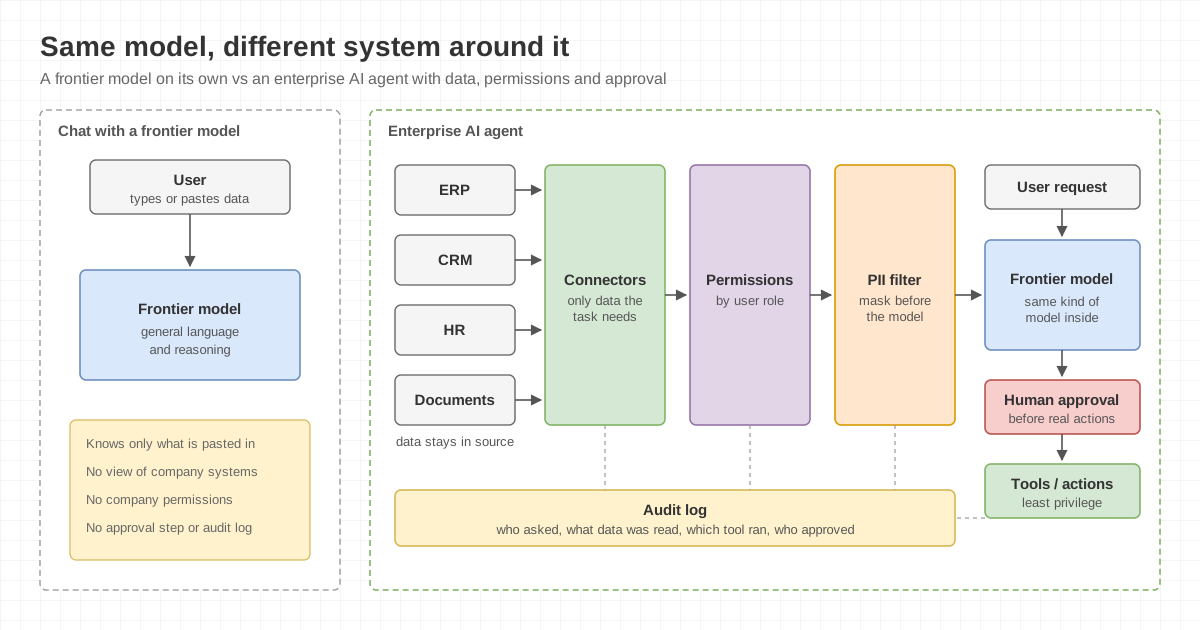
Organizations are beginning to use AI agents for automated work, from managing email to drafting reports. But each AI agent has an identity, system permissions, and API access — all of which create new attack paths:
- Identity Sprawl — one organization may have dozens of AI agents, each with its own access token and permissions. Without proper governance, it is like leaving multiple doors unlocked
- API Security — AI agents primarily communicate through APIs, making API endpoints a top attack target
- Privilege Escalation — attackers no longer need to hack a human account; taking over an AI agent with admin access may be enough to reach everything
- AI Supply Chain — models, plugins, and training data all become new attack surfaces that must be protected
Managing identity in an era where “users” are not just humans, but also AI agents, has become one of the year’s biggest security challenges.
Impact on Thai Organizations: When PDPA Meets Cybersecurity
For organizations in Thailand, the AI cybersecurity arms race brings additional dimensions that must be considered:
PDPA and Cybersecurity Are the Same Business Issue
- Data Breach = PDPA Violation — if personal data is leaked in an attack, organizations must notify the PDPC within 72 hours and may face fines of up to THB 5 million
- Consent Management — if consent management systems are compromised, data may be used without authorization, creating a compounded compliance violation
- Cross-border Data Transfer — organizations using overseas cloud services must ensure security controls are effective across all relevant jurisdictions
Threats Specific to Thailand
- Thai-language Business Email Compromise (BEC) — AI can now generate flawless Thai emails, and legacy phishing filters designed for English often fail to detect them
- Financial Sector Attacks — Thailand is a primary target in the ASEAN region for financial cybercrime
- SMEs as Weak Links — small and medium-sized businesses in the supply chain of large enterprises often have weaker security, making them common entry points for attackers
What Organizations Need to Do — Right Now
Responding to AI-powered threats is not next year’s problem. It is a today problem. Here is a practical framework organizations should begin with:
1. Assess Your Current State (Security Posture Assessment)
- Evaluate how quickly your organization can detect and respond to threats
- If MTTD + MTTR exceeds 30 minutes, your risk is high
- Redo threat modeling to include AI-powered attack vectors
2. Implement Zero Trust Architecture in Practice
- “Never Trust, Always Verify” — every access request must be verified, whether it comes from inside or outside the organization
- Cover both humans and AI agents
- Use micro-segmentation to limit damage in the event of a breach
3. Invest in AI-driven Security
- Firewalls and antivirus alone are no longer enough
- You need behavioral analytics that detect anomalies in real time
- You need automated response that moves faster than human approval workflows
4. Manage Identity Rigorously
- Maintain an inventory of every identity — humans, service accounts, and AI agents
- Apply the principle of least privilege strictly
- Review access rights regularly, not just once a year
5. Prepare an AI-era Incident Response Plan
- Run tabletop exercises for AI-enabled attack scenarios, such as deepfake CEO fraud
- Define clear playbooks for each incident type
- Have a communication plan for PDPA notification requirements to the PDPC
6. Build a Security Culture
- Train employees to recognize AI-powered phishing — old examples filled with typos are no longer useful
- Run phishing simulations using AI-generated, realistic content
- Build a culture of “report first, no blame”
Conclusion: You Cannot Afford to Be Slow in a War Measured in Seconds
The AI Cybersecurity Arms Race in 2026 is not a future issue — it is already happening, every day, to every organization.
A 29-minute breakout time tells us one thing clearly: human-dependent security operations are no longer fast enough. Organizations that want to stay resilient need AI on the defense side that can move faster than the offense.
For Thai organizations, the risk is even more complex because they must deal with both global threats and PDPA obligations at the same time. Having a cybersecurity strategy that covers both dimensions is no longer optional — it is a business necessity.
"The question is no longer whether you'll be attacked by AI — it's whether your defenses can respond faster than the attack."
If your organization is not yet confident that it is ready for AI-era threats, talk to us. We can help assess your current posture and design a defense plan that fits your business context.
Sources
Consult on Cybersecurity Strategy →