Quick Summary
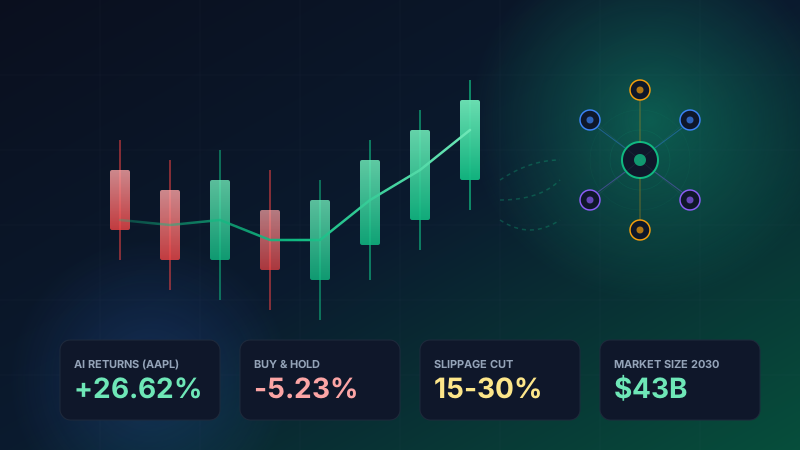
The algorithmic trading market hit $21B in 2024 and is projected to reach $43B by 2030 (CAGR ~12.9%). The biggest accelerator in 2025-2026? The shift from "AI as indicator" to "AI as autonomous agent" — systems that ingest data, analyze, decide, and manage risk entirely on their own.
The TradingAgents research from HKUDS built a multi-agent system with 7 specialized roles that delivered 26.62% cumulative returns on AAPL while buy-and-hold returned -5.23% over the same period.
But here's the part that matters most: no system guarantees profits. Tool subscriptions of $100-$1,000+/month, overfitting risk, flash crash vulnerability, and regulatory compliance are all real costs that must be factored in.
This article covers both opportunity and risk — because good investing starts with complete information.
Disclaimer: This article is for educational purposes only and does not constitute investment advice. All investments carry risk. Investors should conduct their own research before making investment decisions.
Introduction: From 8 Hours of Screen-Watching to a System That Never Sleeps
Picture a trader's typical day.
Up at 5 AM to catch the Asian market open. Three monitors running simultaneously — candlestick charts, order book, Twitter news feed. Fourth cup of coffee at 2 PM because the US market is about to open. By 10 PM, exhaustion sets in — selling too early out of fear, or holding too long out of greed.
This has been the reality for traders for decades.
Now picture something different — a system running 24 hours a day that doesn't get tired, doesn't get greedy, doesn't get scared. Analyzing thousands of data points simultaneously. Deciding based on pre-set criteria. Adapting from outcomes.
That's what AI Agents are doing in trading right now.
2026 isn't the first year of algorithmic trading — Wall Street has been doing this for over 20 years. What's changed is that AI is no longer just another indicator on a chart. It's become an autonomous agent doing the work of an entire trading team — from fundamental analysis and news reading to chart analysis, execution, and risk management.
And the interesting part — this technology isn't limited to hedge funds anymore. Retail investors can access these tools today.
But before the excitement takes over, you need to understand how it works, how well it actually performs, and what traps to watch for.
AI Agents in Trading ≠ Chatbots Answering Questions
Many people hear "AI trading" and think of asking ChatGPT "what stock should I buy?" and getting an answer back.
That's not what we're talking about.
An AI Agent in trading context is a system running an autonomous 4-step loop:
1. Sense — Pull real-time market data, order book, news, sentiment, portfolio state. Everything simultaneously, not one screen at a time.
2. Think — ML models process data, weigh factors, simulate scenarios, and propose actions.
3. Act — Execute orders through order management systems, adjusting size and timing based on real market liquidity.
4. Learn — Measure outcomes against benchmarks, refine strategies, repeat.
This sense-think-act-learn loop runs continuously 24/7 — and that's what separates it from a chatbot that answers a question and moves on.
The Multi-Agent System: 7 Roles in a Virtual Trading Firm
The TradingAgents research from HKUDS paints a clear picture. They built a multi-agent system simulating an entire professional trading firm with 7 specialized roles:
- 4 Analysts — each focused on a different angle: fundamental, sentiment, news, and technical
- Researchers — bullish and bearish sides debate each other, creating balanced perspectives
- Traders — make buy/sell decisions from all the gathered intelligence
- Risk Managers — ensure every decision stays within acceptable parameters
These agents don't just think in isolation. They exchange structured reports, debate like a real team, using ReAct prompting that mixes quick-thinking models (for data retrieval) with deep-thinking ones (for complex analysis).
The result? 26.62% cumulative returns on AAPL during Jun-Nov 2024, while buy-and-hold returned -5.23%. It outperformed every rule-based baseline — MACD, KDJ&RSI, SMA — with superior Sharpe ratios across AAPL, GOOGL, and AMZN.
9 Ways AI Agents Help with Trading
Research from Digiqt analyzing AI agent adoption in the trading industry identified 9 core use cases with proven value:
1. Pre-Trade Analytics
Before placing a large order, AI simulates how that order will impact market price. This helps plan optimal timing and sizing instead of guessing.
2. Smart Order Execution
Instead of dumping an entire order at once, AI slices orders into smaller pieces, routes them intelligently, and adjusts timing based on real-time liquidity. This cuts slippage by 15-30% compared to traditional algorithms.
3. Portfolio Optimization
Not just finding the single best stock, but rebalancing entire portfolios under real constraints — acceptable tracking error, tax implications, ESG criteria — all simultaneously.
4. Market Intelligence
Synthesize information from earnings calls, news, sentiment, and market regime shifts into an overview you can digest in 5 minutes instead of 5 hours of reading.
5. Risk Monitoring
Track VaR (Value at Risk), stress scenarios, and margin exposure in real-time. Get alerts before problems escalate.
6. Trade Surveillance
Detect spoofing, layering, and policy violations — both for self-protection and regulatory compliance.
7. Client Engagement
For brokerages, clients can place trades through conversational interfaces instead of navigating complex order entry systems.
8. Post-Trade TCA
After trades complete, AI analyzes actual transaction costs against benchmarks. What worked, what didn't, what to adjust.
9. Operations Automation
Trade reconciliation, break routing, reporting — work that used to require entire teams, reduced by 40-60%.
Real Numbers: How Well Does AI Actually Trade?
Let's look at actual performance data — both the exciting numbers and the ones that require perspective.
TradingAgents Research Results
The multi-agent system tested on real stocks during Jun-Nov 2024:
| Metric |
TradingAgents |
Buy-and-Hold |
| Cumulative Returns (AAPL) |
+26.62% |
-5.23% |
| Sharpe Ratio |
Higher |
- |
| vs MACD, KDJ&RSI, SMA |
Beat all |
- |
Impressive, but remember — this is a backtest over a specific time period with specific stocks. Future results may differ.
2026 Bot Benchmarks
Currently available AI trading tools report:
- Top AI bots overall: 12-25% annualized returns (varies by strategy and market conditions)
- Stoic.ai Meta strategy: ~45% historical APY, Sharpe ratio >2 (historical, not guaranteed)
- Stoic.ai Fixed Income: 10-20% APY
- GLP Vault: targeting 19% APY with AI + quant strategists
Measurable ROI (Beyond Returns)
What's equally interesting is the reduction in "invisible costs":
- 15-30% slippage reduction vs traditional algorithms — for a mid-size brokerage executing $500M monthly, that's $75K-$150K/month in avoidable slippage
- 40-60% reduction in manual monitoring and reconciliation work
- 3-6 months from pilot to production
These ROI figures are more tangible than return numbers that fluctuate with market conditions.
Notable AI Trading Tools in 2026
The AI trading tools market has grown rapidly. Here are the main categories worth looking at:
Stock Trading
Trade Ideas — Holly AI delivers 5-8 curated trade ideas daily with buy/sell signals and stop-loss levels. Good for those who want a curated shortlist rather than searching themselves.
TrendSpider — AI-powered technical analysis that auto-detects chart patterns. Saves hours of manual trendline drawing.
Tickeron — Identifies 40 chart patterns with AI Trend Prediction that provides confidence levels for each pattern's likely outcome.
Composer — No-code strategy builder. Backtest, then automate. Great for quickly prototyping ideas.
Crypto and Multi-Asset
3Commas — DCA bots, grid bots, and copy trading. High flexibility, but you need to understand each strategy type before deploying.
Cryptohopper — A marketplace of strategies built by others, with backtesting capabilities.
AlgosOne — Fully managed AI trading for those who want AI handling everything.
Full Automation
Public.com — AI agents for conditional trades across stocks, options, and crypto on a single platform.
StockHero — Highly-rated AI stock bot among users.
The Cost Reality
What many people overlook: these tools aren't cheap.
- Basic tier: $100-$300/month
- Pro tier: $300-$1,000+/month
If you have a $3,000 portfolio and pay $300/month for tools, you'd need to generate 10%+ monthly returns just to break even — which isn't realistic.
High subscription costs eat directly into small retail investors' profits. This is a serious consideration.
Maximum Profit Strategies
If you've decided to use AI for trading, here are 5 approaches used by professional investors:
Strategy 1: Multi-Timeframe Analysis with AI Confirmation
Instead of watching a single timeframe, have AI analyze multiple timeframes simultaneously — daily, 4H, 1H — and only enter trades when all timeframes align.
Upside: significantly reduces false signals.
Downside: misses fast-moving opportunities in some timeframes.
Strategy 2: Sentiment + Technical Fusion
Combine sentiment data (news, social media, earnings calls) with technical analysis. Not just charts alone, not just news alone.
AI excels here because it can synthesize multiple data sources simultaneously, while humans process information sequentially.
Strategy 3: Portfolio Rebalancing Under Constraints
Not just "buy the best stock" but rebalance the entire portfolio within defined constraints — tracking error below X%, no over-concentration in single industries, tax impact considerations.
AI's advantage is considering multiple constraints simultaneously without forgetting any. Humans tend to focus on returns and forget other constraints.
Strategy 4: Arbitrage and Market-Neutral Approaches
Find price discrepancies between correlated markets or assets — strategies requiring speed and precision where AI outperforms humans.
But understand this — easy arbitrage opportunities have been closed by high-frequency traders who've invested millions in infrastructure. What remains requires increasingly higher sophistication.
Strategy 5: Risk-First — Protect Capital, Then Grow
The most overlooked strategy: use AI to limit damage, not to maximize profits.
Set hard position limits, kill switches, pre-trade risk checks. If the portfolio drops X%, stop trading immediately. No negotiation, no emotion interfering.
Investors who survive long-term aren't those with the highest gains. They're those with the smallest losses during downturns.
What to Watch Out For — The Dark Side of AI Trading
If you've read this far feeling excited, I'd like you to temper that excitement. The dark side of AI trading is just as substantial as the bright side.
No System Guarantees Profits
Let me be crystal clear: no AI in the world can guarantee you'll make money.
TradingAgents delivered 26.62% over 6 months on one stock. That's a historical test result under specific market conditions. It doesn't mean it'll repeat in the future.
Overfitting — When AI Masters the Past But Fails the Present
A common problem: bots that backtest brilliantly but lose money live. They've overfit to historical data — like a student who memorizes past exam answers perfectly but can't handle a new exam.
Flash Crashes — When AI Systems Crash the Market Together
Picture this — thousands of bots detect the same signal, sell simultaneously, prices plunge, other bots see the plunge and sell more, creating a domino effect that crashes the market in seconds.
This isn't theory. It's happened multiple times in history. And as AI trading becomes more widespread, this risk increases.
Red Flags to Run From
If you encounter an AI trading tool making these claims, run:
- "Guaranteed X% monthly returns" — nobody can guarantee that
- "Secret AI nobody else has" — if it's that good, why are they selling it to you?
- "You must decide now" — pressure to act fast because they don't want you thinking
- "All our clients profit" — unverifiable fake testimonials
- Not disclosing losses — honest systems show both gains and losses
Regulatory Compliance
Both the SEC in the US and the SEC Thailand have rules about automated trading — from reporting requirements and audit trails to market manipulation restrictions.
Using AI to trade without understanding these regulations could create legal problems, especially when trading on foreign exchanges.
When to Override AI
AI doesn't have emotions — that's an advantage in normal conditions. But in unprecedented situations (black swan events), the ability to "feel" that something is wrong is something AI still doesn't do well.
The COVID crash of 2020, the Silicon Valley Bank crisis of 2023, unexpected geopolitical events — in these situations, human judgment with contextual understanding may be better than AI trained on historical data that's never seen such events.
Always have a kill switch. Always have human-in-the-loop for crisis situations.
Getting Started: A 4-Step Roadmap
Step 1: Learn Investment Fundamentals First (Don't Skip This)
AI is a tool, not a shortcut. If you don't understand what P/E ratio means, why an inverted yield curve is concerning, or why position sizing matters — AI won't help you. It'll actually help you lose money faster.
Read foundational books, take courses, understand market mechanics before touching AI tools.
Step 2: Start with Paper Trading / Demo Accounts
Most tools offer demo mode. Use simulated money, test strategies, see how the AI actually performs — not just what the marketing materials claim.
Paper trade for at least 3 months before using real money. Observe results in both up and down markets.
Step 3: Invest Only What You Can Afford to Lose
When you're ready for real money, start with an amount that won't affect your daily life if you lose it all. Don't use savings, retirement funds, or borrowed money — no matter how good the AI looks.
Step 4: Measure, Adjust, Repeat
Measure results weekly and monthly against benchmarks (like the SET index or S&P 500). If results aren't good, adjust your strategy — but don't change strategies every week. Switching too frequently means you never have enough data to properly evaluate anything.
Set criteria in advance for how many weeks you'll give each strategy before deciding.
From Enersys — A Software House Perspective
Why is Enersys writing about this?
We're a Software House specializing in Odoo ERP, Enterprise AI, and Data Privacy (PDPA). We build AI systems for businesses — and trading is one of the most complex and interesting applications.
What We Do
- Agent orchestration — design and build multi-agent systems that collaborate, not just single agents
- Data pipelines — build data flows that ingest real-time data, clean it, and feed it to models
- Risk systems — risk management systems with guardrails, audit trails, and kill switches
- Odoo ERP integration — connect trading systems to Odoo for automated financial tracking, reporting, and reconciliation
- PDPA compliance — handle financial data responsibly under Thai data protection law
What We Don't Do
We don't say "use our bot and you'll get rich" — that's not what an honest Software House would say.
What we do is build systems that work reliably, with appropriate guardrails and compliance support. Returns depend on strategy, market conditions, and the user's risk management.
If you're interested in building a custom analytics or trading system for your business, we'd be happy to talk.
Conclusion
AI Agents are genuinely changing the trading world — from indicators on a chart to autonomous systems that do the work of entire trading teams.
Numbers from research and real tools show the potential: 26.62% returns from TradingAgents, 15-30% slippage reduction, 40-60% less manual work.
But potential doesn't equal guaranteed results. High tool costs, overfitting risk, flash crashes, regulations, and black swan events that AI can't handle — these are all part of the equation.
Good investing starts with complete information, not excitement.
And most importantly — technology is a tool, not an answer. Those who use the tool well will have an edge. But those who rely on the tool alone without understanding fundamentals will find that even the best tool can't help them.
This article is for educational purposes only and does not constitute investment advice. All investments carry risk. Investors should conduct their own research before making investment decisions.
Sources