Systems That Wait for Instructions Are Becoming Obsolete
Picture this: it’s the end of the month, and your accounting team is just as overwhelmed as always. Invoices are piling up, accounts need to be reconciled, and reports have to reach executives before midnight. Now imagine your ERP system handling all of that on its own—without anyone clicking through screens, without chasing people by email for missing data, and without anyone staying late to finish the job. Sounds unrealistic?
It’s not anymore.
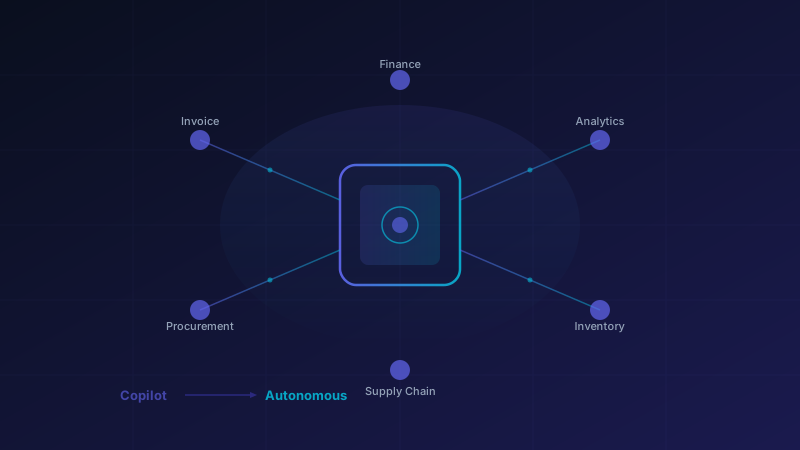
The world of AI Agents in ERP is shifting from AI as a mere “assistant” that needs to be told what to do, to systems that can plan and act independently from start to finish. In the industry, this is called Autonomous Operations, and it is quickly becoming the next standard in business.
The Numbers Don’t Lie — What the Market Is Saying
Let’s be direct: when leading research firms are all pointing in the same direction, this is more than just another buzzword.
In a February 2026 report, Gartner stated clearly that embedding AI directly into cloud ERP will help companies achieve a 30% faster financial close by 2028. That means an organization that currently takes 10 days to close the books at month-end could bring that down to 7 days. And that’s not just about convenience—it means making decisions faster than competitors.
The market signals are hard to ignore:
- The AI-in-ERP market was worth $5.8 billion in 2025 and is projected to reach $58 billion by 2035—a 10x increase in just one decade.
- The AI Integration Platform market, valued at $7.8 billion in 2024, is growing at 19.7% annually and is expected to hit $37.6 billion by 2033.
- Snowflake and OpenAI recently signed a $200 million partnership to develop agentic AI specifically for enterprise use.
And perhaps the most interesting figure comes from actual users: 98% of manufacturers worldwide are exploring AI, but only 20% say they are truly ready.
The gap between 98% and 20% is where the opportunity lies for businesses that prepare early.
Why ERP Is Becoming AI’s Main Battleground
Some may wonder: why ERP? Why not AI chatbots or AI in marketing? Why focus on what looks like the most boring system in the company?
The answer is simple: ERP sits at the center of enterprise data.
ERP holds everything—from purchase orders and inventory to finance, HR, and supplier relationships. If AI operates here, it gains visibility across the entire business and can connect decisions across functions in ways that are very difficult for humans to do consistently.
Imagine this: the system detects that a product category is running low, estimates when replenishment is needed, checks prices across multiple suppliers, creates a purchase order, routes it for approval, and updates accounts payable automatically. All of that happens before anyone even realizes stock is about to run out.
That is what Autonomous ERP looks like in practice.
The 3 Eras of AI in ERP
To understand where we are today—and where we are heading—it helps to look at the evolution.
Era 1 — Automation (Rule-Based Systems)
Early ERP systems relied on simple automation: predefined rules such as “if stock drops below X, send an alert” or “if the amount exceeds Y, send an email.” The system could only follow instructions. It had no ability to “think” or adapt.
Era 2 — Copilot (AI as an Assistant)
This is where many organizations are today. AI acts like an intelligent assistant that recommends, analyzes, and summarizes information. But humans still make the decisions. People still need to open the system, review the reports, and click confirm.
Copilot is a big step up from basic automation—but the bottleneck is still the same: people.
Era 3 — Autonomous (AI Works End-to-End on Its Own)
This is the era now emerging. An AI Agent is not just an assistant—it is an “agent” with goals, planning ability, and the capacity to take action without waiting for human instructions at every step.
The key difference is that AI Agents in ERP can:
- Set goals on their own, such as “complete the financial close by the 3rd of the month”
- Break work down into smaller tasks and execute them step by step
- Handle problems that arise during the process and find ways around them
- Report back to humans only when an actual decision is needed
Use Cases Where the Impact Is Most Visible
To be clear, Autonomous ERP is not right for every process today. But there are certain areas where it can be transformative almost immediately.
Financial Close and Reconciliation
One of the most time- and labor-intensive tasks in finance is the month-end and year-end close. AI Agents can manage this process from collecting data across departments to reconciling figures, detecting anomalies, and generating final reports. Work that once required a team of five people over five days could shrink to just one or two days. Gartner says the industry-wide improvement could reach 30% by 2028.
Autonomous Procurement
From checking inventory levels and analyzing demand to creating purchase orders, sending them to suppliers, tracking deliveries, and even paying invoices—this workflow can operate in near-autonomous mode. Humans only need to review exceptional cases, such as high-value or high-risk transactions.
Document Management and Unstructured Data
This has long been one of ERP’s biggest weaknesses. A huge portion of business data lives in formats systems struggle to read: PDF invoices, contracts, emails, or scanned documents. Recently, SageX introduced an AI layer that automatically converts unstructured documents into ERP-ready data. For many companies, this solves in one leap a problem they have wrestled with for decades.
Demand Forecasting and Supply Chain
AI Agents can analyze historical sales, market trends, weather, special events, and dozens of other variables to produce far more accurate demand forecasts than traditional models. They can then automatically adjust production and purchasing plans based on those forecasts.
Why 80% Still Aren’t Ready
Let’s return to that striking figure: if 98% are exploring AI but only 20% are ready, what is holding back the other 80%?
Across many organizations, the same problems keep showing up:
Data issues
- Data is scattered across multiple disconnected systems
- Data quality is too poor for AI to operate reliably
- There is no clear data governance
Infrastructure issues
- The existing ERP is an older on-premise system that is difficult to integrate with AI
- There are too many legacy systems that need to be connected gradually
- APIs or integration layers are missing or inadequate
People and process issues
- Teams still do not understand how AI Agents differ from traditional automation
- There is no clear process defining what AI can decide on its own and what still requires human review
- There are concerns over accountability if AI makes a wrong decision
Strategy issues
- There is no clear roadmap for moving from today’s state to autonomous operations
- The company invests in tools but not in process design or change management
To put it simply, most of the problem is not technology—it is organizational readiness.
A Framework for Businesses That Want to Get Started
No one goes from zero to fully autonomous in a single leap. What works is taking it step by step.
Step 1 — Assess & Clean
Before thinking about AI, you need to understand the condition of your current data. Key questions include:
- How accurate and complete is your master data?
- Which systems store critical data, and can they talk to each other?
- Which processes are relatively simple and suitable for an initial AI pilot?
Step 2 — Pilot on a High-Impact Process
Do not try to transform everything at once. Choose one or two processes that are:
- Repetitive, rules-based, and time-consuming for staff
- Easy to monitor and correct if errors occur
- Likely to produce clear measurable results, such as lower processing time or a reduced error rate
Step 3 — Design Human-in-the-Loop Properly
Good autonomous AI does not mean AI with no human involvement at all. It means AI that knows when to act independently and when to ask for help. You need to design:
- Guardrails — clear limits within which AI can make decisions, such as transactions below a certain amount
- Escalation paths — criteria for when the issue must be passed to a human
- Audit trails — every AI decision must be recorded and reviewable
Step 4 — Scale & Optimize
Once the pilot succeeds, expand into other processes using what you learned. Each rollout becomes faster because the infrastructure and the team’s mindset are already in place.
Looking Ahead — What ERP Will Look Like in 2028
Now imagine this: by 2028, a strong ERP system will no longer be one that waits for people to input data. It will be a system that:
- Receives data from everywhere—PDFs, emails, factory sensors, and real-time market feeds
- Processes and decides within predefined workflows without waiting for someone to open a laptop
- Alerts people only to what matters so executives receive distilled insights rather than raw data they must interpret themselves
- Learns and improves from the outcomes of every decision it makes
Snowflake and OpenAI are investing $200 million together because they see this as the future—and they want to help build it.
What Thai Businesses Need to Watch Out For
To be frank, the rise of AI in ERP comes with risks that businesses need to understand upfront.
Do not be distracted by features that sound impressive but fail in real use
Many ERP and AI vendors use the word “autonomous” in marketing, but in reality their systems still require significant human supervision. Ask very clearly what “autonomous” actually means in the context of the solution they are selling.
Do not transform faster than your organization can absorb
Technology moves faster than people. If the organization is not ready, implementing AI too quickly can create confusion and resistance.
The data AI uses must be secure and compliant
This is especially true for HR and financial data, which are subject to regulation. AI usage must comply with PDPA and other applicable requirements.
Do not overlook vendor lock-in
Most ERP AI Agent solutions are tied to a specific platform. Think ahead: if one day you want to switch vendors or expand to another platform, will that still be possible?
Evaluate Your Readiness Before Taking the Next Step
Before making any investment decisions, ask yourself these straightforward questions:
- Which ERP process currently consumes the most employee time, and is it repetitive?
- Where does the data entered into ERP each day come from, and are there still too many manual data entry steps?
- If ERP makes a wrong decision, how serious would the impact be—and how quickly would you know?
- Is the team using ERP today ready to work with AI that can “think” and act independently, or do they still need training and change management?
If you can answer these clearly, you will know whether you are in the 20% that are ready—or in the 80% that still need preparation.
Conclusion — Don’t Let Competitors Move First
A market growing from $5.8 billion to $58 billion over the next decade does not mean this technology belongs to some distant future. It means the competitive race has already started. Companies that transform early will build advantage day by day, while companies that wait will find the gap widening over time.
A 30% faster financial close may not sound dramatic at first. But for executives making business decisions, having real numbers three to four days ahead of competitors every month compounds into a massive long-term advantage.
So the question is no longer, “Should we use AI in ERP?” The real question is, “How do we start in the right direction?”
If you want to discuss where your organization stands on this journey and where to begin for the fastest impact, contact the Enersys team — no sales pitch, just a practical conversation first.
References
Gartner (February 2026) — "Gartner Predicts Embedded AI in Cloud ERP Applications Will Drive a 30 Percent Faster Financial Close by 2028" — https://www.gartner.com/en/newsroom/press-releases/2026-02-24-gartner-predicts-embedded-ai-in-cloud-erp-applications-will-drive-a-30-percent-faster-financial-close-by-2028
ERP Software Blog (March 2026) — "Agentic AI in ERP: Autonomous Operations" — https://erpsoftwareblog.com/2026/03/agentic-ai-in-erp-autonomous-operations/
Robotics and Automation News (March 2026) — "What Will Be the Most Widely Adopted AI Solution in 2026?" — https://roboticsandautomationnews.com/2026/03/06/what-will-be-the-most-widely-adopted-ai-solution-in-2026/99304/
ERP News Magazine (March 2026) — "ERP News Magazine March 2026 Issue 58" — https://erpnews.com/erp-news-magazine-march-2026-issue-58/
Electronics Media (March 2026) — "AI Integration Platform Market" — https://www.electronicsmedia.info/2026/03/27/ai-integration-platform-market/