Imagine telling an AI: "Check the pending invoices, match them against POs, and send them for CFO approval" — and it actually does it. Not just summarizing the data. Not just drafting an email. But logging into your systems, pulling the records, validating them, and executing the workflow to completion.
This is not science fiction — this is Agentic AI, and it is reshaping enterprise operations across the globe in 2026.
What Is Agentic AI? Why Is It Different?
The AI we have known for the past 2–3 years is Generative AI — ask a question, get an answer. Request a draft email, get a draft. Ask for a summary, get a summary. But every step still requires a human to copy, paste, verify, and execute.
Agentic AI is fundamentally different:
| Generative AI | Agentic AI |
|---|---|
| Answers when asked | Acts when given a goal |
| Single-step, needs prompting at each stage | Plans and executes multi-step workflows |
| No access to external systems | Connects to and controls real systems |
| Provides information for decisions | Makes decisions and takes action |
| Example: "Summarize this invoice" | Example: "Process this invoice, match PO, send for approval" |
In simple terms — Generative AI is an assistant waiting for instructions. Agentic AI is a manager who understands the task, plans the approach, and gets it done.
Key Players in the Agentic AI Arena in 2026
The competition in 2026 is no longer about "who generates better text" — it is about "who can do more work autonomously".
OpenAI — Operator
OpenAI launched Operator, capable of controlling browsers and completing tasks across websites with an 87% success rate on complex operations — from filling forms and booking tickets to executing online transactions.
Anthropic — Claude Computer Use
Anthropic developed Claude to directly control computers — opening applications, clicking buttons, typing data, and orchestrating multiple sub-agents simultaneously, with a strong emphasis on safety and human oversight.
Google — Gemini Agents & Project Mariner
Google leverages its ecosystem across Google Cloud, Workspace, and Android, launching Gemini Enterprise with AI Agents that handle multiple concurrent tasks on cloud-based virtual machines.
Microsoft — Copilot Agents & Dynamics 365
Microsoft embeds Agentic AI directly into Dynamics 365, covering Sales, Service, Finance, Supply Chain, and HR. Copilot Cowork enables multi-step, cross-application work that can run for hours — not limited to a single prompt.
Open Standards — Model Context Protocol (MCP)
Notably, these players are converging on shared standards. MCP (Model Context Protocol) was donated to the Linux Foundation in February 2026, becoming a vendor-neutral standard for tool integration between AI and external systems. Over 10,000 active MCP servers are now in production worldwide.
Proven Enterprise Use Cases
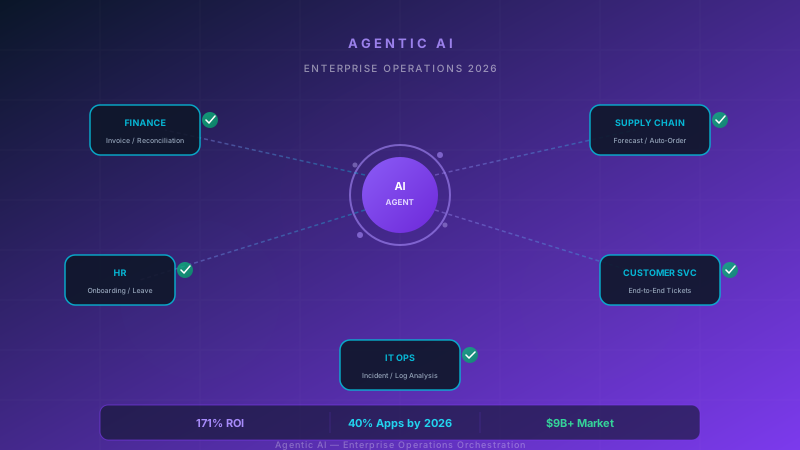
1. Finance — Invoices, Expenses, and Reconciliation
Accounts Payable is one of the areas where Agentic AI delivers the clearest results:
- A mid-sized manufacturing firm deployed AI Agents for end-to-end invoice processing — from document ingestion and data extraction to PO matching and approval routing. Results: 75% cost reduction and 90% faster invoice processing with over 99% accuracy.
- A global food distribution company used AI Agents to reduce AP steps from 6 to 2, processing over 8.5 million invoices per year from more than 100,000 suppliers.
- Finance teams using AI Agents process invoices with 7x fewer clicks and close books up to 2 days earlier.
2. HR — Onboarding and Leave Management
AI Agents in HR go far beyond answering benefits questions:
- Automated Onboarding: When a new employee joins, the AI Agent handles everything — creating accounts across systems, sending documents for signature, scheduling orientation, notifying IT to prepare equipment, and automated follow-ups.
- Leave Management: AI Agents check remaining leave balances, verify organizational policies, review team schedules, then automatically approve or escalate to the appropriate authority.
- Employee Self-Service: Employees ask questions about entitlements, benefits, or policies via chat, and the AI Agent searches actual organizational documents and responds with references.
3. Supply Chain — Forecasting, Ordering, and Negotiation
Supply chain is another area where Agentic AI creates massive impact:
- Demand Forecasting: AI Agents analyze historical sales data, weather patterns, market trends, and supplier lead times to forecast product demand in advance.
- Auto-Reordering: When stock hits reorder points, the system generates Purchase Orders automatically, with AI Agents selecting the optimal supplier based on price history, quality, and delivery performance.
- Supplier Negotiation Support: AI Agents analyze market data, compare pricing across multiple suppliers, and prepare negotiation briefs for procurement teams, including potential volume discount recommendations.
4. Customer Service — End-to-End Ticket Resolution
AI Agents in customer service are not just FAQ chatbots:
- Full Resolution: AI Agents receive tickets, look up customer data, check order status, execute remediation (refunds, replacements, credit adjustments), and close tickets — all without human handoff.
- Intelligent Escalation: When encountering cases too complex to handle, AI Agents summarize all context and hand off to human agents seamlessly, so customers never need to repeat themselves.
- Proactive Outreach: AI Agents detect issues before customers do (e.g., delayed shipments) and reach out proactively with solutions.
5. IT Operations — Automated Incident Response
IT Ops is one of the fastest-adopted arenas for AI Agents:
- Automated Incident Response: AI Agents detect alerts, analyze logs, identify root causes, and execute initial remediation (restart services, scale resources, rollback deployments).
- Log Analysis & Pattern Detection: AI Agents analyze logs from multiple systems simultaneously, identifying anomalous patterns and alerting teams before issues materialize.
- Change Management: AI Agents review change requests against policies automatically, assess risk, and approve low-risk changes without waiting for CAB meetings.
The Numbers Speak — ROI from Early Adopters
Data from organizations that have deployed Agentic AI in 2025–2026:
| Metric | Result |
|---|---|
| Average ROI | 171% (U.S. enterprises: 192%) |
| vs. Traditional Automation | 3x higher |
| Executives achieving ROI within Year 1 | 74% |
| Organizations seeing productivity gains | 66% |
| Organizations expecting ROI over 100% | 62% |
| Agentic AI market size (2026) | $9.14–10.86 billion |
| Projected 2034 market | $199 billion (38x growth) |
A concrete example — AtlantiCare (a U.S. healthcare organization) deployed an AI Agent for 50 clinical providers with an 80% adoption rate, reducing documentation time by 42% and saving an average of 66 minutes per day per physician.
Gartner predicts that by end of 2026 — 40% of enterprise applications will embed AI Agents, up from less than 5% in 2025. Looking further ahead to 2035, Agentic AI could drive 30% of enterprise software revenue, exceeding $450 billion.