From Chatbots to AI That Can Actually Get Work Done
In 2025, we became familiar with AI as chatbots that could answer questions. By 2026, the picture has changed significantly — Agentic AI is no longer limited to responding. It can think, plan, and take action across multiple systems on its own.
Gartner predicts that 40% of enterprise applications will have embedded AI Agents by the end of 2026 — up from less than 5% in 2025. Meanwhile, IDC expects AI copilots to be embedded in nearly 80% of enterprise software by the end of the same year.
The Real Market Signals Emerging Now
Data from multiple sources confirms this is not just hype:
- Salesforce closed Q4 of fiscal year 2026 with more than 22,000 Agentforce deals and 2.4 billion Agentic Work Units
- Anthropic launched Enterprise Agents with 13 prebuilt plugins for HR, finance, and engineering
- OpenAI introduced Frontier — an AI Agent management platform for enterprises
- GitHub released Enterprise AI Controls, allowing organizations to manage AI Agents from a single control point
Every major player is moving in the same direction: AI is no longer an add-on feature, but the core of the application
MCP — The New Standard That Lets AI Agents Connect to Every System
The biggest challenge for enterprise AI Agents is connecting with existing systems — 46% of executives say this is the number one bottleneck.
The industry’s answer is Model Context Protocol (MCP), originally created by Anthropic and transferred to the Linux Foundation in late 2025. Today, OpenAI, Google, Microsoft, and thousands of developers are using MCP as a shared standard.
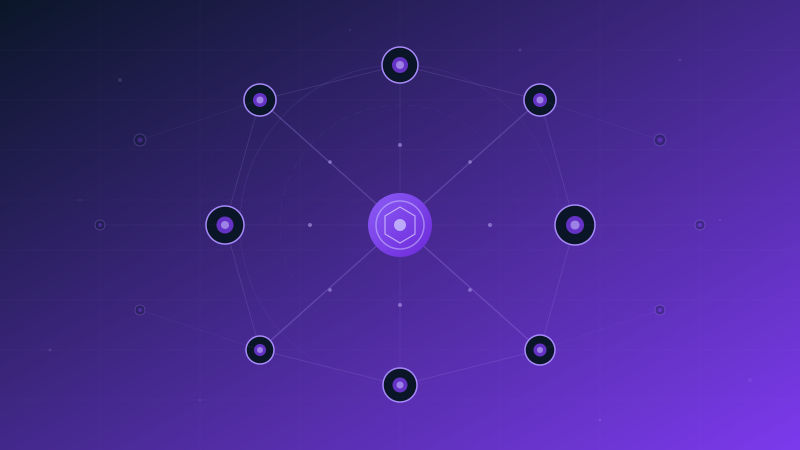
MCP works like the USB-C of AI — it defines how AI Agents connect to databases, ERP, CRM, Google Drive, Slack, or any other system through a single protocol, eliminating the need to build new integrations every time.
Multi-Agent Systems — Multiple Agents Working Together
A growing trend is multi-agent orchestration — instead of relying on a single AI to do everything, organizations are starting to deploy multiple specialized Agents that work together:
- Sales Agent analyzes leads, prioritizes them, and routes them to the sales team
- Support Agent receives cases, diagnoses issues, and escalates only the cases that require human intervention
- Finance Agent reviews invoices, matches them against POs, and flags irregular entries
- HR Agent screens resumes, answers onboarding questions, and manages leave requests
Gartner predicts that by 2027, one-third of Agentic AI implementations will be multi-agent architectures that combine multiple Agents with different skill sets.