PinnacleArc International — Business Overview
PinnacleArc International Co., Ltd. (pseudonym used to protect client confidentiality) is an import-export company established more than 12 years ago. The business has its headquarters in Bangkok, three warehouse locations (Laem Chabang, Bangna, and a Sukhumvit showroom), 52 employees, and annual revenue of approximately 350 million THB.
Its core business is importing industrial parts from China, Japan, and Taiwan, then reselling them to manufacturers in Thailand and exporting to CLMV markets (Cambodia, Laos, Myanmar, and Vietnam). Main product categories include bearings, hydraulic parts, linear motion guides, and CNC machine spare parts.
Mr. Wichai (pseudonym), Managing Director: "We started with just two people in a small shophouse 12 years ago. Back then, Excel could handle everything. But once revenue passed 200 million baht, I started feeling like I was driving by looking only in the rearview mirror — I never really knew what our actual profit was at that moment."
Pain Points — Problems That Built Up to a Breaking Point
1. Excel Hell — 47 Files No One Dared Touch
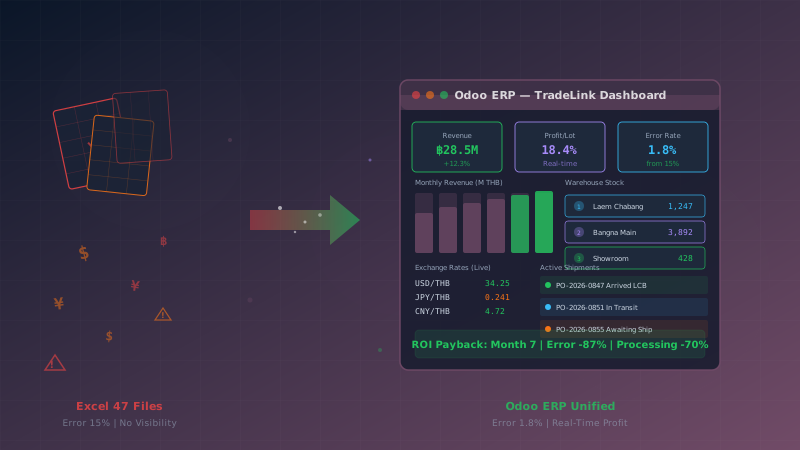
PinnacleArc was using 47 Excel spreadsheets to run everything, from purchase orders, invoices, and packing lists to stock cards and daily exchange rates.
The problems were clear:
- The master file containing data for more than 4,200 SKUs lived on only one employee’s computer. If she was out sick, no one could update it.
- The costing file had 8–10 layers of nested Excel formulas, and no one wanted to touch it for fear of breaking it.
- Data was not synchronized. Sales created quotations using price files that were already two weeks outdated because they didn’t know purchasing had updated supplier prices.
- Version conflicts happened regularly. In one month alone, the February PO file was accidentally overwritten with an older January version, and the team spent three days recovering the data.
Ms. Mam, Accounting: "At the end of every month, I had to consolidate data from 12 different files. It took 4–5 days just to find out whether we made a profit or a loss — and even then, I still wasn’t sure the numbers were accurate."
2. Multi-Currency Nightmare — Five Currencies Changing Every Day
PinnacleArc’s import-export operation had to manage five currencies at the same time:
| Currency |
Used For |
Problem |
| USD |
Purchases from China/Taiwan |
Some suppliers invoice in USD |
| JPY |
Purchases from Japan (bearings, guides) |
Exchange rates fluctuate 0.5–1% per day |
| CNY |
Chinese suppliers billing in yuan |
Often use rates different from BOT |
| THB |
Domestic sales |
Selling prices fixed for 30–60 days |
| USD (export) |
Exports to CLMV |
Customers pay in USD, but reporting is in THB |
A real incident: In November 2025, PinnacleArc placed a large bearing order from Japan worth 8.2 million JPY. At PO issuance, the rate used was 0.235 THB/JPY. But when payment was made 45 days later, the rate had risen to 0.248 THB/JPY — increasing cost by 106,600 THB with no prior provision.
Mr. Wichai: "That month I thought we made 2.1 million baht in profit. Once accounting closed the books, it turned out to be only 1.4 million. We lost 700,000 baht to exchange losses that no one had flagged."
3. Inventory Chaos — Three Warehouses, Never Matching
PinnacleArc’s inventory was spread across three locations:
- Laem Chabang warehouse — goods just cleared through customs, waiting to be transported to Bangkok
- Bangna warehouse — main warehouse with ready-to-ship stock
- Sukhumvit showroom — samples and fast-moving items for walk-in customers
The issue was that the stock card at Laem Chabang was still paper-based, while Bangna and the showroom each used separate Excel files.
- Sales would call the warehouse asking, "Do we have model 6205-2RS bearings in stock?" The warehouse would say "200 units," but when preparing shipment, they discovered 80 had already been reserved for another order.
- Goods in transit from Laem Chabang to Bangna had no system status at all — they effectively "disappeared" for 3–5 days.
- During the December 2025 cycle count, inventory in the system (Excel) differed from actual stock by 23%, with more than 2.8 million THB in missing inventory value.
Mr. Ek, Warehouse Manager: "I knew where the items were, but that knowledge existed only in my head. If I wasn’t around, the team had to call me every hour."
4. Customs & Compliance — Government Documents Prepared Manually
As a BOI-promoted company, PinnacleArc had to handle a large volume of compliance documents:
- Form E (Certificate of Origin for ASEAN-China FTA) — every form required manual entry of product details, HS codes, and FOB value
- Customs declarations — had to match the invoice, packing list, and bill of lading exactly
- BOI reports — monthly and annual import-export reporting
- Import VAT — required monthly reconciliation against purchase records
All of these documents were created manually. Every time, staff had to copy data from Excel into Word templates field by field.
A real incident: In October 2025, the documentation team entered an HS code incorrectly by one digit on a customs declaration (8482.10 instead of 8482.01), causing the shipment to be held at the port for five days. The combined penalty, demurrage, and opportunity cost came to 180,000 THB.
5. Cash Flow Blind Spot — No Visibility into Which Lots Made or Lost Money
This was the most serious issue. The cost of a single import lot included:
- Product cost (FOB)
- Sea freight
- Insurance
- Import duty + import VAT
- Customs broker fees
- Inland transportation (Laem Chabang → Bangna)
- Exchange rate on the actual payment date
But this information was spread across six different sources: purchasing Excel files, accounting Excel files, shipping receipts, customs broker receipts, bank statements, and tax invoices. No one could calculate the true total cost of a lot.
Mr. Wichai: "We had 350 million baht in annual revenue, but if you asked me what our net profit was, I had to wait 2–3 months after period close to find out. That means I was making daily decisions without knowing our real financial position."
6. Late Delivery — Lead Times Nobody Was Tracking
Some of PinnacleArc’s suppliers were reliable, while others were repeatedly late. But there was no system to track:
- Where each issued PO currently stood
- Which suppliers were late most often
- Whether ordered goods had shipped, boarded the vessel, or arrived at port
The purchasing team had to search email thread by thread for updates. If a supplier didn’t reply, nobody knew when goods would arrive. When customers called, all they could say was, "We’ll check and get back to you."
Business impact: In 2025, three customers worth a combined 28 million THB/year switched to competitors because "deliveries were late and no one kept us informed."
Analysis — Root Cause Assessment
When PinnacleArc engaged the Enersys team, we spent three weeks in discovery workshops with every department. We identified four core root causes:
Root Cause 1: No Single Source of Truth
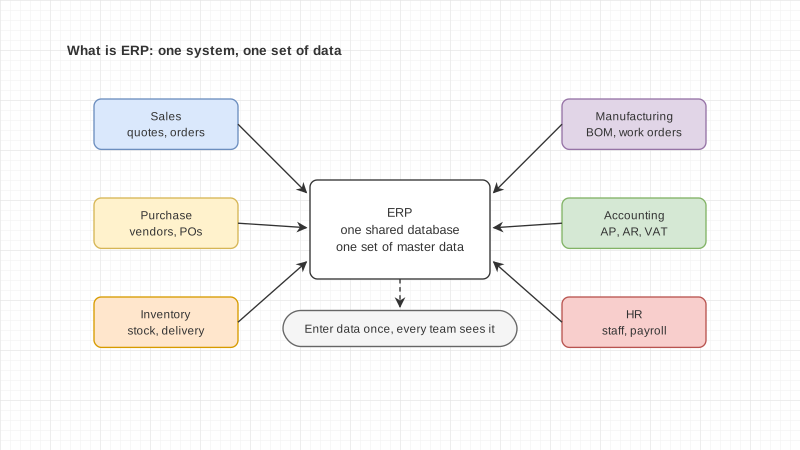
Data was scattered across dozens of Excel files, different people, and different computers. There was no single version of the truth that everyone could trust. Once people stopped trusting the system, they fell back on personal experience and memory — which lived in the heads of only a few key employees.
Root Cause 2: Disconnected Processes
The process from Inquiry → Quotation → PO → Shipping → Receipt → Invoice → Payment was a broken conveyor belt, split into isolated steps. Each department completed its part and then passed information to the next via printouts, email, or phone calls. There was no system automatically carrying data forward.
Root Cause 3: No Real-Time Visibility
Management could only see "snapshots of the past" in month-end reports. They never had a live view of the business, which led to slow decisions, wrong decisions, or hesitation to make decisions at all.
Root Cause 4: Risk Concentrated in Individuals
If Ms. Mam was sick, accounting close stalled. If Mr. Ek went on vacation, the warehouse couldn’t answer basic stock questions. If someone in purchasing resigned, no one knew which POs were pending follow-up.
Enersys team: "PinnacleArc’s problem wasn’t that its people lacked capability — the team was highly capable and worked extremely hard. The issue was that the tools weren’t supporting them. It was like asking skilled craftsmen to build a high-rise using only hammers and nails in an era when cranes already exist."
Tradeoffs — A Serious Comparison of the Options
PinnacleArc did not choose Odoo from the start. We guided management through four options, evaluated across six criteria:
Option 1: Enterprise ERP (Leading Global Brand)
Pros:
- Strong global reputation and customer confidence
- Comprehensive modules for trading companies
- Excellent multi-currency support
- Thai localization available (tax, invoicing)
Cons:
- High license cost: approximately 3.5–5 million THB (52 users)
- Implementation cost: 4–8 million THB, taking 8–14 months
- Annual maintenance: 18–22% of license cost
- Separate consultants required for customization
- Expensive post-go-live changes
Assessment: Over PinnacleArc’s budget (set at 3 million THB) and too slow to implement.
Option 2: Cloud Subscription ERP (Global Vendor)
Pros:
- Cloud-native, no server maintenance required
- Built-in multi-subsidiary and multi-currency capabilities
- Powerful dashboards and analytics
- Well suited for trading and distribution
Cons:
- Subscription cost: approximately 2.8–4 million THB/year (per-user pricing)
- Implementation: 3–6 million THB, taking 6–10 months
- Data hosted overseas, which may raise compliance concerns
- Costs rise linearly as user count increases
- Limited Thai-language support
Assessment: Annual cost was too high for a 52-person company.
Option 3: Keep Excel and Add Point Solutions
Pros:
- Minimal change to existing workflows
- Lower cost (buy software only where needed)
- Can be used immediately without waiting for a long implementation
Cons:
- Treats symptoms, not root causes
- Data remains fragmented across systems
- Integrations between tools must be built manually
- Likely to return to the same problems in 2–3 years
- No single source of truth
Assessment: Mr. Wichai rejected this option himself — "I don’t want to patch the same problem and wait for it to explode again."
Option 4: Odoo Enterprise
Pros:
- Lower license cost: approximately 400,000–600,000 THB/year (52 users)
- Open-source core allows deep customization without vendor lock-in
- Complete connected modules: Purchase, Sales, Inventory, Accounting, Documents
- Built-in multi-currency and multi-warehouse support
- Thai localization available (VAT, withholding tax, tax invoices)
- Implementation is 2–3 times faster than major ERP brands
- Faster ROI because it is modular and can be rolled out step by step
Cons:
- Less brand recognition in Thailand than major ERP names
- Requires a highly capable implementation partner — not every partner understands trading businesses
- The free Community Edition lacks key features, so Enterprise is necessary
- Custom modules require developers who understand the Odoo framework
Assessment: The best fit for PinnacleArc’s size and budget.
Side-by-Side Comparison Table
| Criteria |
Enterprise ERP |
Cloud ERP |
Excel+ |
Odoo |
| Year 1 Budget |
8–13M |
6–10M |
0.5–1M |
1.5–2.5M |
| Annual Cost |
1–1.5M |
2.8–4M |
0.2M |
0.4–0.6M |
| Implementation |
8–14 months |
6–10 months |
1–2 months |
3–5 months |
| Multi-Currency |
Excellent |
Excellent |
Poor |
Good |
| Multi-Warehouse |
Good |
Excellent |
Very poor |
Good |
| Thai Localization |
Excellent |
Fair |
None |
Good |
| Scalability |
Excellent |
Excellent |
Poor |
Excellent |
| Flexibility |
Low |
Medium |
High |
Very high |
Solution — Why Odoo Was Chosen and How It Was Implemented
The 3 Key Reasons Behind the Decision
Reason 1: Fastest ROI
With a 2.2 million THB budget (implementation + first-year license), PinnacleArc expected payback within 8–10 months from reduced errors, fewer late-delivery penalties, and exchange-rate losses it could now prevent.
Reason 2: Modular Rollout
No need for a big-bang launch or forcing all 52 employees to switch systems in one day. Modules could be introduced gradually, reducing change-management risk.
Reason 3: Enersys Understands Both Odoo and Trading Operations
PinnacleArc chose Enersys as its implementation partner because we do more than just install software. We understand import-export business processes — from letters of credit, Incoterms, and HS codes to BOI compliance.
Implementation Plan: 4 Months, 4 Phases
Phase 1 (Month 1): Foundation — Master Data + Purchase + Inventory
Goal: Establish a single version of the truth
What we did:
- Migrated master data for 4,200 SKUs into the system, including HS codes, units of measure, and linked suppliers
- Set up all 3 warehouses plus internal transfer routes (Laem Chabang → Bangna → Showroom)
- Implemented the Purchase module covering RFQ → PO → Receipt
- Set reordering rules for the first 200 fast-moving SKUs
- Configured multi-currency for USD, JPY, CNY, and THB with automatic BOT exchange-rate updates
Mr. Ek: "The first day I opened the system and saw stock across all three warehouses on one screen, I just stared at it for 10 minutes. In eight years of working here, I had never seen that kind of visibility."
Phase 2 (Month 2): Sales + Quotation + Customer Management
Goal: Give the sales team tools better than Excel
What we did:
- Set up the sales pipeline from Lead → Quotation → Sales Order → Delivery → Invoice
- Created price lists by customer group (factories, traders, CLMV)
- Built quotation templates for frequently sold product bundles
- Added credit limit management so sales could not exceed limits without MD approval
- Connected sales to inventory in real time, so quotations could be based only on available or incoming stock
Phase 3 (Month 3): Accounting + Thai Localization + Bank Integration
Goal: Eliminate duplicate data entry in accounting
What we did:
- Set up the chart of accounts in line with Thai accounting law and approved by the company’s auditor
- Automated tax invoices, credit notes, and withholding tax documents
- Implemented landed cost calculation so every import cost component flows automatically into product cost
- Enabled multi-currency gain/loss journals for automatic realized and unrealized FX calculations
- Integrated bank reconciliation by importing statements and auto-matching them to invoices
Ms. Mam: "What used to take five days is now ready before month-end. I only need to review and adjust it — one day is enough."
Phase 4 (Month 4): Documents + Reporting + BOI Compliance
Goal: Ensure documents are 100% accurate without manual retyping
What we did:
- Built document templates for invoices, packing lists, commercial invoices, and certificates of origin — all populated directly from sales orders
- Created BOI report templates pulling import-export totals directly from the system instead of Excel
- Designed real-time dashboards for the MD: revenue, profit, cash position, AR/AP aging
- Developed supplier performance reports: on-time delivery rate, quality score, and average lead time
- Built a custom Profit per Lot report combining every cost component from FOB through inland transportation
Change Management — The Hardest Part Was Not the Technology
One of the biggest lessons from this project was that technology accounted for only 30% of success — the other 70% was people.
Challenges We Faced
Challenge 1: "The old way still works"
Some employees, especially long-tenured team members, felt Excel was still good enough. Why change?
How we handled it: We didn’t force the point — we showed it. We walked the team through how many times data had to be keyed in for one order (answer: 7 times), then asked: "If we reduce that to 1 time, what could you do with the time saved?"
Challenge 2: "What if I break something?"
In the first week after go-live, staff were afraid of clicking the wrong thing and causing damage, so work initially took twice as long.
How we handled it: We set up a sandbox environment for two weeks of practice before go-live and appointed one super user per department who received intensive training and could support their team.
Challenge 3: "What if old data disappears?"
Employees worried that all the historical data in Excel would be lost.
How we handled it: We archived every Excel file in a folder that remained accessible at all times. Nothing was deleted or hidden. Usage simply declined naturally until it reached zero.
Mr. Wichai: "What I appreciated was that Enersys never came in saying, 'Your old system is terrible.' Instead, they said, 'Your old system was very good — but the company has outgrown those tools.' That made the team feel supported rather than criticized."
Success — Measurable Results
After six months post go-live (January–June 2026), these were the measurable outcomes:
Order Processing Time
| Metric |
Before |
After |
Improvement |
| Time to create 1 PO (incl. approval) |
2.5 hrs |
35 mins |
-77% |
| Time to create 1 quotation |
45 mins |
12 mins |
-73% |
| Time to prepare invoice + packing list |
1.5 hrs/lot |
20 mins/lot |
-78% |
| Month-end closing time |
5 days |
1.5 days |
-70% |
| People required per order-processing lot |
3 people |
1 person |
-67% |
Error Rate
| Metric |
Before |
After |
| Incorrect product data in PO/Invoice |
15% |
1.8% |
| Incorrect HS code on customs declaration |
3–4 times/year |
0 times (6 months) |
| Inventory discrepancy |
23% |
3.2% |
| Incorrect exchange rate usage |
8–10 times/year |
0 times |
Financial Visibility
| Metric |
Before |
After |
| Profit/loss visibility |
End of month (after close) |
Real-time, every day |
| Profit per lot |
Never calculated |
Visible immediately when lot closes |
| Cash position |
Check statements manually |
Dashboard updated daily |
| Aging AR/AP |
Monthly report only |
Visible at all times |
| FX gain/loss |
Known at year-end |
Visible immediately upon payment |
Business Impact (6 Months After Go-Live)
- Reduced exchange-rate losses: from approximately 1.2 million THB/year to about 180,000 THB/year (based on the first six months), thanks to earlier visibility and timely hedging
- Reduced demurrage/penalties: from about 350,000 THB/year to zero (none occurred during the six-month period), because documents were 100% accurate
- Won back a customer: 1 of the 3 lost customers resumed business after seeing clear improvements in delivery tracking
- Reduced overtime costs: about 45,000 THB/month saved from accounting no longer needing month-end OT
- ROI achieved: in month 7, 1–3 months faster than projected
Mr. Wichai: "The number I like most isn’t the cost savings. It’s that for the first time in 12 years, I can open a dashboard and immediately know where the company stands. I make decisions faster and invest more confidently because the data is there to support me."
5 Key Lessons from This Project
Lesson 1: Don’t Choose ERP by Brand Name — Choose by Fit
Top global ERP brands are excellent for large enterprises with the right budget. But for SMEs that need faster ROI, Odoo is often the right-sized answer — not too small to fall short, and not too large to become wasted capacity.
Lesson 2: The Implementation Partner Matters More Than the Software
Odoo is highly flexible — but that also means it can be configured poorly if the partner doesn’t understand the business. If the implementation team doesn’t know what landed cost is, doesn’t understand FOB vs. CIF, and has never worked with Form E, the system can be set up incorrectly from day one.
Lesson 3: Change Management Must Start Before Day 1
We began workshops with the PinnacleArc team two weeks before implementation even started, helping everyone understand why the company needed to change, not just how the new system worked. People who understand the reason behind change adapt much faster.
Lesson 4: Roll Out Gradually — Don’t Go Big Bang
Launching one module at a time gave the team room to adjust. If a bug appeared, it could be fixed before affecting the next module. More importantly, the team saw quick wins early, which built momentum and confidence for later phases.
Lesson 5: Real-Time Data Changes Company Culture
When everyone sees the same data, meetings shift from "Who has the numbers?" to "The numbers show X — what should we do?" The conversation moves from gathering data to making decisions, and meeting effectiveness improves significantly.
PinnacleArc’s Future Roadmap
PinnacleArc is already planning Phase 2 for late 2026:
- CRM Module — track leads and customer journeys from inquiry through repeat order
- Shipping Integration — connect APIs with shipping lines for real-time container tracking
- AI-assisted Demand Forecasting — use 12 months of historical data to predict future orders
- E-commerce — open an online ordering channel for regular customers
Mr. Wichai: "Six months ago, I was worried this might be money wasted. Today, I’m asking myself why we didn’t do this three years earlier."
Is Your Import-Export Business Facing Similar Problems?
If you’re managing your import-export business with dozens of Excel files, can’t tell which lots are profitable and which are losing money, never trust your inventory numbers, or keep losing margin to exchange-rate movements without realizing it — you’re not alone, and these problems can be solved.
The Enersys team is ready to help analyze your challenges and design a solution that fits your business size and budget.
Free consultation, no charge
Talk to the Enersys team
References
- Market Research Future — Southeast Asia ERP Software Market (USD 0.80B → $1.50B by 2034, CAGR 7.20%)
- Mordor Intelligence — Thailand Digital Transformation Market (USD 10.06B in 2025, SME segment growing at 14.95% CAGR)
- Thailand Business News — Thai Exports 2025 hit USD 339.64B (+12.9% YoY)
- KPC Team — Why 55-75% of ERP Projects Fail
- Odoo S.A. — Official Pricing