Introduction — When AI Becomes 10x More Accessible, Everything Changes
Imagine this: what cost your business 1 million baht per month in AI inference yesterday could drop to just 100,000 baht tomorrow.
That is not a thought experiment — it is exactly what the NVIDIA Vera Rubin Platform is expected to make possible in the second half of 2026.
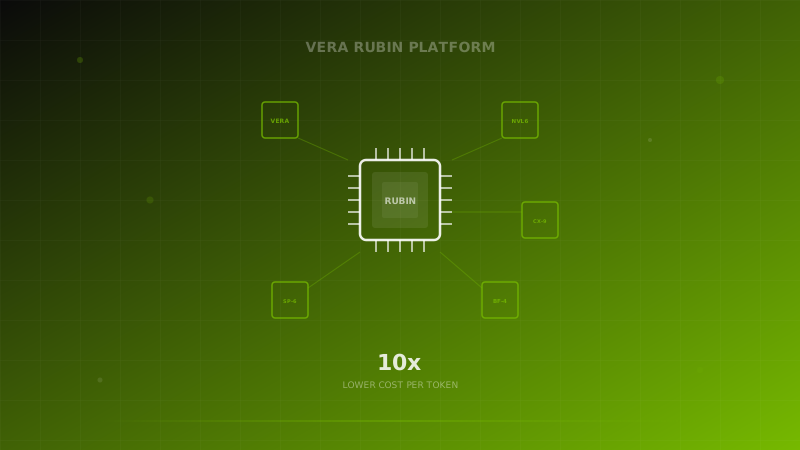
On the CES 2026 stage, Jensen Huang announced that Vera Rubin has entered full-scale production — a platform that brings together 6 new chips in one tightly integrated system, purpose-built for the era of Agentic AI, and capable of reducing inference cost per token by 10x compared with Blackwell.
For Thai organizations planning their AI roadmap, this is a turning point worth paying close attention to.
What Is Vera Rubin? — 6 Chips, 1 Platform
Vera Rubin is not just another GPU launch. It is a full-stack platform designed to work as one system, from chips all the way through the network.
The 6 Core Chips in the Vera Rubin Platform
| Chip |
Primary role |
| Vera CPU |
Custom 88-core CPU (Olympus cores) based on Arm v9.2 architecture |
| Rubin GPU |
AI-focused GPU — 50 PFLOPS inference (NVFP4) |
| NVLink 6 Switch |
GPU-to-GPU interconnect at 3.6 TB/s per GPU |
| ConnectX-9 SuperNIC |
Network card delivering 800 Gb/s per port |
| BlueField-4 DPU |
Smart NIC-style data processor that boosts inference by 5x |
| Spectrum-6 Ethernet |
102.4 Tb/s switch with Silicon Photonics |
All six chips were co-designed together. This is not a platform assembled from separate parts after the fact — it was built from the ground up as an integrated system.
The Numbers That Change the Game — Vera Rubin vs Blackwell
These are the comparisons that matter most:
Inference Performance
| Metric |
Blackwell |
Vera Rubin |
Improvement |
| Inference throughput per watt |
1x (baseline) |
10x |
10x higher |
| Cost per token |
1x (baseline) |
0.1x |
90% cheaper |
| Inference performance |
1x |
5x |
5x faster |
Training Performance
| Metric |
Blackwell |
Vera Rubin |
Improvement |
| GPUs required for MoE models |
4x |
1x |
4x fewer GPUs |
| Training performance |
1x |
3.5x |
3.5x faster |
Rack-Scale Specs (NVL72)
- 72 Rubin GPUs + 36 Vera CPUs per rack
- 260 TB/s aggregate NVLink bandwidth
- 50 PFLOPS NVFP4 inference per GPU (enormous at rack scale)
- 288 GB HBM4 per GPU with 22 TB/s bandwidth (2.8x Blackwell)
- 336 billion transistors per GPU
These numbers do not simply mean “faster.” They mean the cost structure of AI is being fundamentally rewritten.
Why Does “10x” Matter So Much?
Now look at it from a business perspective:
1. AI chatbots that used to be too expensive may suddenly make sense
Organizations that previously calculated TCO for AI customer service and concluded that it was “not worth it yet” may need to revisit the math. With inference costs down by 90%, the economics change immediately.
Example: A company with 100 customer service staff spending 500,000 baht per month on AI inference could see that figure drop to 50,000 baht — turning ROI positive within the first month.
2. Agentic AI could accelerate rapidly
AI agents that need to “think” through multiple steps consume a large number of tokens. If token costs fall by 10x, agent-based workflows that were once too expensive can become profitable very quickly.
Vera Rubin was designed specifically for agentic reasoning. The Vera CPU’s Olympus cores are optimized for the kind of sequential reasoning AI agents rely on.
3. Large models become much more accessible
Trillion-parameter models that previously required hundreds of GPUs can now be trained or fine-tuned with only a quarter of the hardware. That opens the door for mid-sized organizations to work with much larger models than before.
Cloud Providers Will Be Ready in H2 2026
For organizations that do not want to invest in hardware directly, there is good news: all major cloud providers are preparing Vera Rubin instances.
Cloud providers expected to launch first
- AWS (Amazon Web Services)
- Google Cloud Platform (GCP)
- Microsoft Azure
- Oracle Cloud Infrastructure (OCI)
AI cloud partners
- CoreWeave — a GPU cloud favorite among AI startups
- Lambda — focused on ML training and inference
- Nebius — a European AI cloud provider
- Nscale — sustainable AI infrastructure
Server manufacturers
Cisco, Dell, HPE, Lenovo, and Supermicro will all build Rubin-based systems — including rack-scale NVL72 deployments and the server-board HGX Rubin NVL8.
That means Thai organizations do not need to wait to procure hardware themselves — they can access this new level of performance simply by spinning up cloud instances.
The Impact on Thailand’s Data Center Market — Timing Could Not Be Better
Vera Rubin is arriving at an especially favorable moment for Thailand.
Data center investment in Thailand is surging
- AWS has announced $5 billion in Thai data center investment
- Microsoft plans to invest more than $1 billion in cloud and AI infrastructure between 2026 and 2028
- Google is investing $1 billion in a data center in Chonburi
- Thailand’s BOI has approved a total of 36 data center projects worth more than $23.1 billion
Thailand’s data center market is expanding rapidly
The market is projected to grow from $1.45 billion in 2025 to $6.29 billion by 2031 — a CAGR of 27.71%.
The Thai Data Center Association is targeting 1 GW of capacity by 2027.
Vera Rubin + a ready Thai data center ecosystem = major opportunity
Thai organizations stand to benefit on both fronts:
- AI inference costs drop by 10x with Vera Rubin
- Lower latency from data centers located in Thailand
- Data sovereignty — data does not need to leave the country, helping meet PDPA requirements
NVLink 6 and Spectrum-X Photonics — Why the Network Matters as Much as the GPU
One point many people miss is this: AI performance does not depend on the GPU alone. It also depends on the network connecting GPUs together.
NVLink 6 — The expressway between GPUs
- 3.6 TB/s per GPU (up from 1.8 TB/s in Blackwell — 2x higher)
- 260 TB/s aggregate bandwidth across the rack
- Supports FP8 in-network compute through the SHARP protocol — allowing certain computations to happen inside the switch rather than sending them back to the GPU
Spectrum-X Photonics — Light instead of electricity
- Uses Silicon Photonics (co-packaged optics)
- Cuts network power consumption by 5x compared with conventional transceivers
- Delivers 10x greater reliability
Why does that matter? Because as AI workloads become more complex — especially Agentic AI, where multiple agents may need to coordinate — the bottleneck is often no longer the GPU itself, but the network between GPUs. Vera Rubin addresses that problem at the foundation.
BlueField-4 DPU — A Hidden Weapon for Enterprise AI
The most interesting chip in the platform may not even be the GPU. It may be the BlueField-4 DPU:
- 64 Grace CPU cores inside the DPU itself
- Support for 20 million IOPs at 4K block size
- Includes NVIDIA Inference Context Memory Storage (ICMS) — a system purpose-built for storing KV cache for inference
Why is this important for enterprises?
- Security — BlueField-4 ASTRA supports multi-tenant architecture and Confidential Computing
- Storage performance — can improve inference throughput by up to 5x through storage optimization
- Efficiency — offloads network and storage processing from the GPU, allowing the GPU to focus entirely on AI workloads
For organizations that must comply with PDPA and need strong data isolation between customers, Confidential Computing is a critical feature.
What Thai Organizations Should Do to Prepare
Short term (now through Q3 2026)
- Revisit your AI cost model — if your previous TCO showed that AI “wasn’t worth it,” recalculate using costs that are 10x lower
- Redesign your AI roadmap — use cases that were once too expensive may now be practical
- Strengthen your data foundation — cheaper compute is not useful if your data is still not ready
Mid term (H2 2026–2027)
- Test Vera Rubin instances with your existing cloud provider
- Benchmark AI workloads against your current Blackwell-based instances
- Plan for Agentic AI — lower costs make more complex agent workflows economically viable
Long term (2027+)
- Consider on-premise Vera Rubin for workloads that require full data sovereignty
- Build an AI-first culture — once AI becomes this much cheaper, the question is no longer “Should we use AI?” but “How do we use AI to outperform competitors?”
Strategic Perspective — Why This Is About More Than Hardware
What NVIDIA is doing with Vera Rubin is not just releasing a faster GPU. It is changing the economics of AI across the entire industry.
When inference costs drop by 90%:
- AI agents that were once too expensive become commercially viable
- Real-time AI no longer has to trade off between quality and affordability
- Thai SMEs gain access to enterprise-grade AI capabilities
- Startups get longer runway because inference no longer consumes as much of the budget
"When the cost of technology drops by 10x, what changes is not just the price — it is the number of use cases that become possible."
Every time compute costs fall this dramatically, entirely new categories of applications emerge. Cloud computing made SaaS possible. Mobile computing made Uber and Grab possible.
Vera Rubin could be the starting point for the next wave of AI applications.
Timeline Comparison: From Hopper to Vera Rubin
| Platform |
Year |
Inference per watt (relative) |
Cost per token (relative) |
| Hopper (H100) |
2023 |
1x |
1x |
| Blackwell (B200) |
2024-2025 |
~3x |
~0.3x |
| Vera Rubin (R100) |
H2 2026 |
~30x |
~0.03x |
In just three years, inference costs have dropped by more than 30x — a pace of cost reduction far beyond Moore’s Law.
Conclusion — An Opportunity Worth Paying Attention To
The NVIDIA Vera Rubin Platform represents an inflection point for AI infrastructure:
- 6 new chips co-designed as a single platform
- 10x lower inference cost compared with Blackwell
- Cloud instances available in H2 2026 on AWS, GCP, Azure, and OCI
- Thailand is becoming an ASEAN data center hub with more than $23 billion in investment
For organizations still hesitating on AI, a 10x drop in cost may be the variable that changes every equation.
The question is no longer “Should we use AI?” — it is “When should we start, and where should we begin?”
Ready to Build Your AI Strategy?
The Enersys team has experience helping Thai organizations plan AI infrastructure — from evaluating use cases and calculating TCO to real-world deployment.
Whether you are just getting started or looking for ways to optimize your existing AI costs, we can help.
Talk to the Enersys team for free
References