The Starting Point — From a Viral Open Source Project to an Enterprise Platform
If you’ve been following the AI industry over the past four months, you’ve probably heard of OpenClaw — an open-source AI agent framework that shattered GitHub records with 250,000+ stars in under four months, surpassing React to become one of the most watched software projects in the world.
But popularity came with a major problem: enterprise-grade security.
AI agents that run autonomously 24/7, send data over the internet, access local files, and make decisions on their own — that’s exactly the kind of thing keeping CTOs and CISOs awake at night.
At GTC 2026 on March 16, NVIDIA CEO Jensen Huang took the stage to introduce NemoClaw — the company’s answer to that problem.
What is NemoClaw?
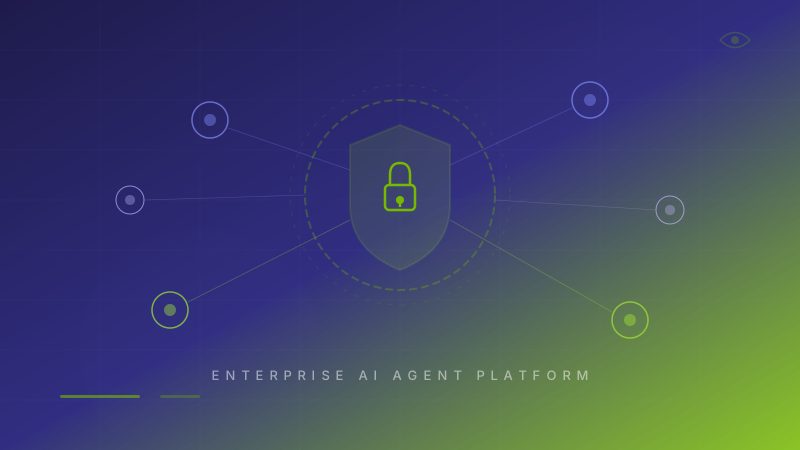
NemoClaw is NVIDIA’s enterprise AI agent platform. It takes OpenClaw and layers it with advanced security controls, along with high-performance AI models from the Nemotron family.
In simple terms:
NemoClaw = OpenClaw + Enterprise Security (OpenShell) + NVIDIA Nemotron Models
What makes NemoClaw interesting isn’t just that it combines powerful technologies. It addresses the core issues that have kept large organizations from adopting AI agents seriously.
Why Are Enterprises Afraid of AI Agents?
Before NemoClaw, organizations looking to deploy AI agents kept running into the same challenges:
1. Data risk
AI agents can access sensitive data and send it to external servers — customer records, financial information, trade secrets. In the wrong setup, all of it could leak.
2. Lack of behavioral control
An autonomous agent might make the wrong call, email customers without approval, or modify critical data without anyone reviewing the action first.
3. Regulatory compliance
Laws such as Thailand’s PDPA or Europe’s GDPR make it clear that personal data must be protected. Uncontrolled AI agents could easily violate those requirements.
4. No auditability
When an agent makes a mistake, who is accountable? Without complete logs and traceability, finding the root cause becomes extremely difficult.
How Does NemoClaw Solve These Problems?
A sandbox that controls every access point
At the heart of NemoClaw is OpenShell, a sandboxing system that keeps AI agents operating inside a controlled environment. Every network connection, file access request, and API call is governed by predefined policies.
Think of it as a transparent cage — the agent can think and act inside it, but it cannot reach beyond the boundaries you set.
Real-time policy updates
What sets NemoClaw apart from a typical sandbox is that policies can be changed instantly without stopping the agent. That means IT teams can adjust permissions in real time as situations change.
Nemotron models that are 9x faster
NemoClaw runs on NVIDIA’s own Nemotron models. According to the company’s published information, they offer:
- 9x faster processing compared with alternative options
- 20% higher accuracy on multi-step reasoning tasks
- A smallest model with just 3.6 billion parameters — small enough to run on a laptop
The Big Thing to Watch: NVIDIA Is No Longer Locking Software to Its Hardware
Perhaps the biggest surprise is this: NemoClaw can run without requiring NVIDIA hardware.
That marks a major strategic shift. NVIDIA has traditionally tied its software closely to its own GPUs. But this time, NemoClaw is designed to support everything from:
- GeForce RTX — graphics cards for mainstream PCs and laptops
- RTX PRO — professional workstation hardware
- DGX Station / DGX Spark — enterprise-grade AI supercomputers
- Other hardware — including non-NVIDIA CPUs and GPUs
Jensen Huang explained the reasoning this way:
"This is as important as HTML is, as important as Linux is."
In other words, NVIDIA sees AI agent platforms becoming foundational infrastructure — much like web standards or operating systems. If the platform is tied to only one hardware ecosystem, it can never become an industry standard.
From Clawdbot to OpenClaw to NemoClaw — The Timeline
| Time period |
Event |
| Nov. 2025 |
Austrian developer Peter Steinberger launched "Clawdbot" — an open-source AI agent that worked through WhatsApp, Discord, and Slack |
| Jan. 2026 |
It was renamed "Moltbot" after a trademark concern raised by Anthropic, then renamed again to OpenClaw |
| Feb. 2026 |
OpenClaw became a phenomenon — 250,000+ GitHub stars, and Steinberger moved to OpenAI |
| Mar. 6, 2026 |
NVIDIA officially announced NemoClaw |
| Mar. 16, 2026 |
Jensen Huang unveiled NemoClaw during the GTC 2026 keynote |
Business Impact: Who Wins and Who Loses?
Businesses that stand to benefit
1. Enterprises already waiting to adopt AI agents
NemoClaw reduces the security concerns that have long been the biggest blocker. Security teams can now define detailed policies to control agent behavior.
2. SMEs with limited resources
Because NemoClaw can run on hardware as accessible as a GeForce RTX laptop, smaller businesses do not need to invest in expensive servers from day one.
3. Highly regulated industries
Banking, insurance, healthcare — these sectors need AI systems that are auditable and tightly controlled in how they access data. NemoClaw directly addresses that need.
Businesses that may be at a disadvantage
1. Proprietary AI agent platform vendors
Companies selling closed AI agent platforms will face tougher competition from an open-source-based platform backed by NVIDIA.
2. Vendors selling standalone "AI security" tools
As NemoClaw builds security directly into the platform, the market for separate add-on security products may shrink.
Global Partners
NVIDIA is not making this move alone. Reports indicate that several major technology companies are already testing NemoClaw:
- Salesforce — intelligent CRM systems where agents assist or act on behalf of sales teams
- CrowdStrike — cybersecurity systems where agents detect and respond to threats automatically
- Adobe — creative tools where agents support design and content production workflows
- Cisco — networking systems where agents monitor operations and resolve issues automatically
- Google — integrations with existing cloud and AI systems
What This Means for Thai Businesses
Opportunities
Thailand is moving deeper into digital transformation, and NemoClaw opens up several important opportunities:
- Lower cost of entry — no need for million-baht AI infrastructure investments; businesses can start with a single laptop
- PDPA compliance support — the sandbox helps prevent AI agents from accessing personal data beyond approved boundaries, directly supporting PDPA requirements
- A way for SMEs to compete with larger enterprises — smaller firms can deploy AI agents with security standards closer to those of multinational organizations
Challenges
- Talent and skills — companies still need people who understand both AI and security in order to define the right policies
- Language and local context — Nemotron models may not yet fully support Thai language needs, so they may need to be combined with other models
- Alpha-stage maturity — NemoClaw is still in early alpha and is not yet ready for full production deployment
Conclusion — A Turning Point for Enterprise AI Agents
NemoClaw could be the turning point that moves AI agents from being a "developer toy" to becoming a real enterprise tool — much like Docker helped containers go mainstream, or Kubernetes made orchestration standard practice.
What Thai organizations should do now:
- Track the progress — NemoClaw is still in alpha, but now is the right time to start learning and experimenting
- Assess readiness — review whether your organization already has suitable AI agent use cases and whether your data is ready
- Prepare your team — invest in AI security and policy management skills, which will only become more valuable
- Talk to experts early — don’t wait until the technology is fully mature, because competitors that start first will have a major advantage
If you’d like guidance on adopting AI agents in your organization or want to assess your business’s AI readiness, contact the Enersys team to speak with our experts.
References