TL;DR
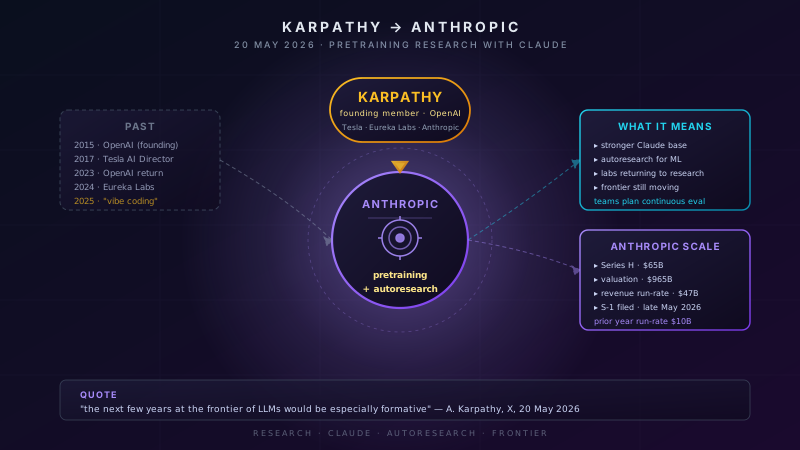
On 20 May 2026, Andrej Karpathy announced on X that he had started work at Anthropic that week. He leads a new team that uses Claude itself to accelerate pretraining research, the large-scale training runs that give Claude its core knowledge and capabilities.
He wrote that the next few years at the frontier of LLMs were likely to be "especially formative," and that he was excited to return to research.
The move is interesting in three ways. The person who coined vibe coding has chosen the lab over applied work. Anthropic has secured a founding-member-level researcher from OpenAI alumni to scale its own research bench. And the concept of autoresearch, which Karpathy demonstrated at Tesla and OpenAI, is about to be brought to bear on Claude.
This piece covers the news, places it in the arc of Karpathy's career, and considers what teams using Claude daily, like Enersys, should take from the signal.
What Happened
Fortune reported on 20 May 2026 that Anthropic had hired Andrej Karpathy and given him a new team that uses Claude as a tool to accelerate pretraining research.
Karpathy confirmed the news on his own X account, which has nearly two million followers. The post was short and unadorned. The frontier of LLMs over the coming years is consequential. He wanted to return to research because the open questions still mattered to him.
His new work is not applied AI or developer tools. It is the foundational training of models, which is where Karpathy spent most of his time at OpenAI and Tesla.
The Career Arc
To read the signal in this news, set it against the rest of his career.
In 2015 he was a founding member of OpenAI in its first cohort. In 2017 he moved to Tesla as Director of AI, owning the Autopilot vision and planning stack. In 2023 he returned to OpenAI briefly, then left within roughly a year. In 2024 he founded Eureka Labs, an education company built on AI, with the stated aim of teaching people to build AI themselves.
In early 2025 he coined the term vibe coding in a single tweet in February. The phrase went viral, and became shorthand for a workflow of writing software by prompting AI loosely rather than carefully. In April of that year he clarified that real AI-assisted coding required disciplined context rather than loose vibes. In April 2026, at Sequoia Capital, he said AI-generated code was still awkward and gross and could not be shipped to production without humans in the loop.
Then in May 2026, he joined Anthropic.
Why Anthropic
Three readings of his statement and context.
The first is that Karpathy wants to be back inside a lab, not building applied products. The big open questions about frontier models still feel unanswered to him, and he wants to be in the room where those questions are asked.
The second is that Anthropic is a lab scaling fast in both research and revenue. The company confidentially submitted a draft S-1 to the SEC in late May 2026, on the back of a $65 billion Series H that took post-money valuation to roughly $965 billion. Revenue run-rate sat at about $47 billion in May 2026, up from roughly $10 billion the prior year. A lab moving at that pace needs senior research talent that can work in depth.
The third is the work itself. Autoresearch is a named concept. Karpathy has demonstrated that large models can accelerate the research process for the next generation of models. Anthropic now wants to put that approach to work on Claude.
What Autoresearch Is
Autoresearch, in plain terms, is using an LLM to do the work that a researcher normally does. Frame the question. Design the experiment. Run iterations. Write the paper.
There is a family resemblance to the AI agents now appearing for general work, except that autoresearch is specialised on machine learning research itself.
If autoresearch produces real reductions in wall-clock time for a research cycle, perhaps cutting it in half or more, the labs that build the best autoresearch systems will release new models more often. The gap between labs that use it and labs that do not will widen faster than many people expect.
That is the bet Anthropic is placing by hiring Karpathy.
What This Means for Teams Using Claude Daily
Enersys uses Claude Code as a daily tool. Developers across the team have Claude sitting beside them as a working pair. Reading this news as a user, three signals stand out.
Pretraining now has a Karpathy-level lead. Over the next six to twelve months, new Claude releases will reflect the work of the team Karpathy now leads. The quality of the base model is likely to step up. Teams running Claude in production need to keep evaluation work ongoing, so they can recognise where the new model improves and where care is still required.
Autoresearch may surface in consumer tools. The systems Anthropic builds for its own researchers may eventually appear as products for outside developers and researchers, in the shape of agents that can do research-style tasks more deeply than Claude does today.
The signal is that AI labs are returning focus to research. Through 2024 and 2025 many labs leaned heavily into enterprise, putting weight on go-to-market. Anthropic investing at this level on a pretraining lead suggests labs are not abandoning research, and still believe there is frontier left to move.
Teams hiring Enersys to do AI integration in the coming year should expect that model capability will continue to move, not stop at the current Claude release. System design has to keep models swappable and evaluation continuous.
Loose Ends
A few open questions.
What happens to Eureka Labs, founded in 2024. Whether Karpathy steps out of an operational role or keeps an advisory presence is not yet clear from the public reporting.
Vibe coding from the writer's seat. In late 2025 and through early 2026 Karpathy publicly complained that AI-generated code was awkward and gross. Returning to pretraining may be his attempt to fix the problem at its source, by making the base model write cleaner code at the training step.
The OpenAI signal. Karpathy was not on OpenAI's payroll through 2025, having left to start Eureka. That he chose Anthropic over a return to OpenAI, or a move to xAI, is itself a talent signal OpenAI will read.
Closing
A piece of news that looks like a single career move, but is in fact the movement of senior talent at a moment when AI labs are scaling capital, revenue, and research benches.
For teams that use Claude every day, like Enersys, it means the base model is likely to keep getting better. Hold the evaluation framework ready, and expect more frequent model transitions over the coming year.
For the field, Anthropic's investment in autoresearch through a researcher of Karpathy's standing says there is still frontier to move. The competitive separation between labs will be decided by their ability to accelerate their own research process, not by GPU count alone.
Sources