The Challenges Thai Organizations Are Facing
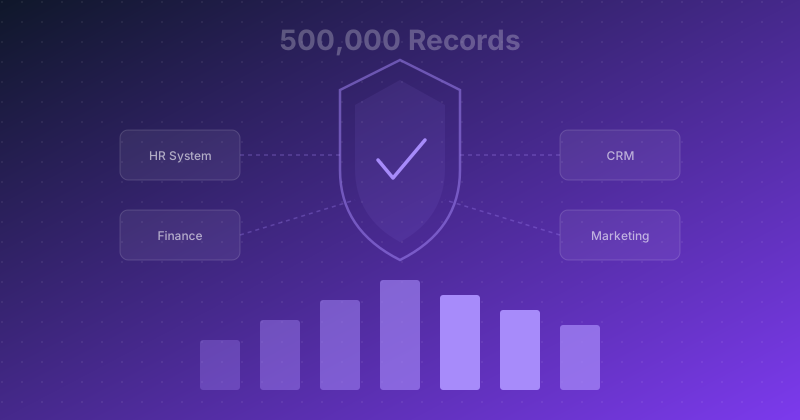
According to surveys by IT consulting firms in Thailand, more than 70% of Thai organizations still manage data in silos — each department stores data in its own systems with no integration and no single source of truth. The same customer’s data may exist in a CRM system, accounting system, HR system, and multiple spreadsheet files, with inconsistent details across each version.
This situation has a direct impact on two critical priorities that Thai organizations are accelerating today.
First, PDPA compliance — when an organization does not know where personal data resides, responding to data subject rights requests (DSARs) becomes difficult. Deleting data as required by law cannot be done completely, and proving that the organization has a lawful basis for processing each dataset becomes nearly impossible.
Second, AI adoption — AI models require clean, accurate, and systematically accessible data. If data is fragmented and lacks standards, the output will not be reliable, in line with the principle of garbage in, garbage out.
The answer to both of these challenges is the same: Data Governance.
What Is Data Governance?
Data Governance is an organizational framework for managing data systematically. It covers defining:
- Who owns the data (Data Ownership) — each dataset has a clearly accountable owner
- Data quality standards — defining what good data looks like: complete, accurate, and up to date
- Access controls — who can access which data, and under what conditions
- Data lifecycle management — how data is created, used, stored, and destroyed
Data Governance is not just about buying tools or software. It is a combination of people, processes, and technology to ensure that organizational data is valuable, trustworthy, and secure.
Why PDPA and AI Both Need the Same Data Governance Foundation
Many organizations treat PDPA compliance and AI readiness as separate initiatives. In reality, both require the same underlying foundation.
Key Areas of Overlap
Data Inventory — PDPA requires organizations to maintain records of processing activities for personal data (Record of Processing Activities), which means knowing what data exists and where it is located. Similarly, building AI models starts with understanding what data is available and ready for use.
Access Control — PDPA requires access to personal data to be limited only to those who need it. AI also requires controls over which models can access which datasets in order to prevent leakage and bias.
Data Quality — PDPA requires personal data to be accurate and current, while AI needs high-quality data to produce accurate outputs.
Comparison Table: Data Governance Requirements
| Topic |
PDPA Requirement |
AI Requirement |
| Data Inventory |
Must know what personal data exists, where it is, and how it is processed |
Must know which datasets are available and in what format |
| Data Classification |
Must distinguish general personal data vs. sensitive data |
Must classify data types to select appropriate features |
| Data Quality |
Data must be accurate, current, and complete |
Data must be clean, consistent, and free from bias |
| Access Control |
Restrict access based on the principle of least privilege |
Control data access for models and developers |
| Data Lineage |
Must be able to trace where data came from and where it was shared |
Must trace the origin of training data and what transformations were applied |
| Retention & Disposal |
Must delete data when the purpose has ended |
Must manage expired training data or data for which consent has been withdrawn |
| Audit Trail |
Must be able to demonstrate legal compliance |
Must be able to explain which data informed model decisions (Explainability) |
As you can see, nearly every requirement aligns across both domains. A single investment in Data Governance can therefore support both objectives.
A 6-Pillar Data Governance Framework
For Thai organizations that want to establish Data Governance systematically, we recommend a framework built on six pillars.
1. Data Inventory and Classification
Start by surveying all data across the organization.
- Create a data catalog that identifies what data exists, which systems contain it, and who owns it
- Classify data by sensitivity level, such as public, internal, confidential, and highly confidential
- Identify personal data by location, and determine whether it is general or sensitive personal data
- Create data mapping to show how data flows between systems
2. Data Quality
Define standards and processes for maintaining data quality.
- Define measurable data quality dimensions such as accuracy, completeness, timeliness, and consistency
- Set KPIs for each dataset’s quality, for example, missing data must not exceed 2%
- Establish regular data cleansing processes, not a one-time cleanup
- Set validation checkpoints before data enters core systems
3. Access Control and Security
Control who can access what data, and under what conditions.
- Use Role-Based Access Control (RBAC) to assign permissions according to job roles
- Apply the principle of least privilege by granting only the access necessary to perform work
- Encrypt data both at rest and in transit
- Use data masking or anonymization for data used in AI development and testing
4. Retention and Disposal
Manage the data lifecycle from creation to destruction.
- Define retention periods for each type of data in line with PDPA and other relevant laws
- Create a verifiable process for deleting or destroying data
- Manage cases where a data subject withdraws consent by removing data from all systems, including AI training data
- Perform backups and archiving systematically with retention policies in mind
5. Metadata Management
Manage data about data (metadata) so the context of each dataset is well understood.
- Record business metadata such as descriptions, owners, and usage purposes
- Record technical metadata such as format, size, source, creation date, and modification date
- Record operational metadata such as update frequency and SLA
- Maintain a data dictionary that everyone in the organization can access
6. Monitoring and Audit
Continuously monitor and review.
- Set up dashboards showing data quality status, access patterns, and compliance status
- Maintain audit logs for data access and modification
- Conduct periodic reviews of policies and processes at least once a year
- Prepare reports for executives and regulators
How to Get Started: A 3-Phase Roadmap
Implementing Data Governance does not require doing everything at once. We recommend splitting the work into three phases.
Phase 1: Data Discovery (Months 1–3)
The goal is to survey and understand the organization’s current state.
- Review all systems that store data across the organization, from core platforms to personal spreadsheets
- Identify data flows between systems, departments, and external parties
- Appoint a Data Governance Committee with representatives from every relevant department
- Conduct a gap analysis against PDPA requirements and AI goals
Phase 2: Classification and Policy (Months 3–6)
The goal is to define policies and classify data.
- Classify data according to the defined classification scheme
- Draft a Data Governance Policy covering all six pillars
- Assign data owners to each dataset with clear responsibilities
- Define data quality KPIs and establish the current baseline
- Design an access control model aligned with the organizational structure
- Define a retention schedule for each type of data
Phase 3: Implementation (Months 6–12)
The goal is to put tools and processes into practice.
- Select and deploy tools for data cataloging, consent management, and data quality monitoring
- Improve access control systems to align with the defined policy
- Build automated data quality checks into core systems
- Train employees at all levels on policies and practices, then begin the first audit cycle
Helpful Tools
Tool selection should be based on the organization’s size and the complexity of its data landscape.
Data Catalog — Tools that collect and index all data across the organization, making it easier to find and understand information. Examples include Apache Atlas, Collibra, and Alation. Smaller organizations can even start with spreadsheets.
Consent Management Platform — A system for managing data subject consent, including collection, changes, and withdrawal of consent in accordance with PDPA requirements. Solutions such as PrivacyHub are specifically designed for Thai organizations.
Data Quality Tools — Tools that automatically monitor and maintain data quality, such as Great Expectations, Soda, and Talend Data Quality. They help detect anomalies and abnormal data patterns.
Data Lineage Tools — Tools that track data flow and transformation, helping answer where a dataset came from and where it has been used.
Common Mistakes
From experience working with many Thai organizations, three recurring mistakes appear again and again.
1. Treating Data Governance as a Project with an End Date
Many organizations launch a Data Governance initiative, work on it for six months to a year, then close the project and declare it “done.” In reality, Data Governance is an ongoing process. Data changes every day, new systems are introduced, and laws are updated. Policies therefore need to be reviewed and improved regularly.
2. No Clearly Defined Data Owner
When accountability is unclear, data is neglected. No one maintains quality, no one decides access, and no one knows when data should be deleted. A data owner does not have to be someone from IT; it should be someone who understands the business context of that dataset. For example, customer data may have the sales manager as its data owner.
3. Focusing More on Tools Than Process
Buying expensive tools does not guarantee strong Data Governance. Without supporting processes, active users, and policy enforcement, tools become wasted spending. Start with process first, then choose tools that support that process — not the other way around.
Summary: Data Governance Is a Single Investment with Dual Benefits
Data Governance is not only an IT issue, and it is not something done merely to pass a PDPA audit. It is the foundation that enables organizations to:
- Comply with PDPA confidently — know where data resides, who can access it, and how to manage it properly
- Adopt AI effectively — have high-quality data ready for use and significantly reduce the time spent preparing data from 80% to much less
- Make better business decisions — by establishing a reliable single source of truth
Organizations that put Data Governance in place today will gain a clear competitive advantage in the near future — both in legal compliance and in creating value from data through AI.
Ready to get started? — Use the PDPA Compliance Assessment to measure your current status, or try the AI Readiness Assessment to see how prepared your organization’s data is for AI. For organizations seeking a PDPA-ready consent management system, explore PrivacyHub now, or contact Enersys for specialized consultation.