A Situation Executives Need to Watch Closely
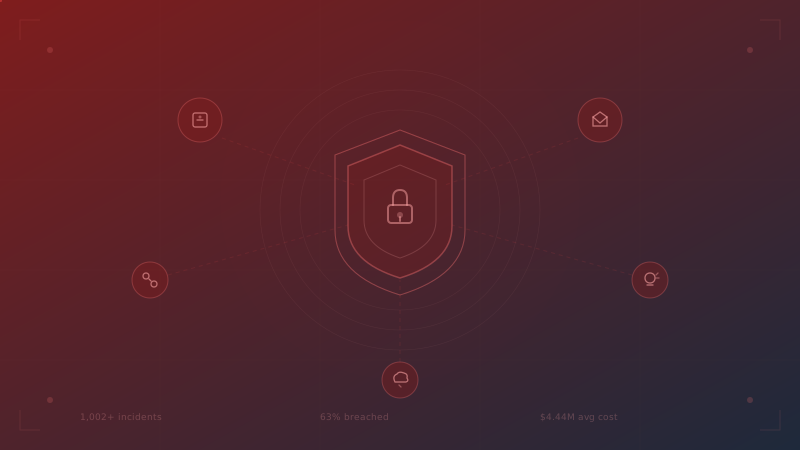
In the first five months of 2025, Thailand recorded more than 1,002 cyber threat incidents, according to the National Cyber Security Agency (NCSA). That number is rising rapidly as the country moves into 2026.
Even more concerning is this: more than 63% of Thai organizations have experienced a data breach, and 52% admit they have paid a ransom in response to ransomware attacks. These figures show that many Thai businesses are still not prepared for threats that are becoming more sophisticated every day.
5 Cyber Threats Thai Businesses Will Face in 2026
1. More Sophisticated Ransomware
Ransomware no longer just encrypts data. Modern cybercriminal groups now use a “double extortion” strategy — encrypting data while also threatening to publish customer information publicly. According to Sophos, 62% of critical infrastructure organizations, including energy companies, have experienced ransomware attacks.
In 2025 alone, more than 10 new ransomware groups emerged, with Southeast Asia — especially Singapore, Thailand, the Philippines, and Taiwan — becoming a primary target region.
2. AI-Powered Phishing
Cybercriminals are now using AI to create phishing emails and messages that look almost indistinguishable from legitimate communications. This includes flawless Thai-language content, voice cloning, and even deepfake video calls impersonating executives.
3. Supply Chain Attacks
Supply chain attacks are becoming one of the most serious threats because attackers do not target your systems directly. Instead, they come through software or service providers you already trust. Just one outdated plugin can open the door to your entire environment.
4. Shadow AI — An Internal Risk
IBM’s Cost of a Data Breach Report 2025 revealed that 97% of organizations breached through AI had no AI access controls in place, and 63% had no AI governance policy at all. Shadow AI — employees using unapproved AI tools — increased the average cost of a data breach by as much as USD 670,000.
5. Cloud Misconfiguration
As organizations move more systems to the cloud, configuration errors are becoming one of the top vulnerabilities. Common examples include publicly exposed storage buckets, API keys hard-coded into source code, and overly broad IAM permissions.
PDPA and Cybersecurity: Two Sides of the Same Coin
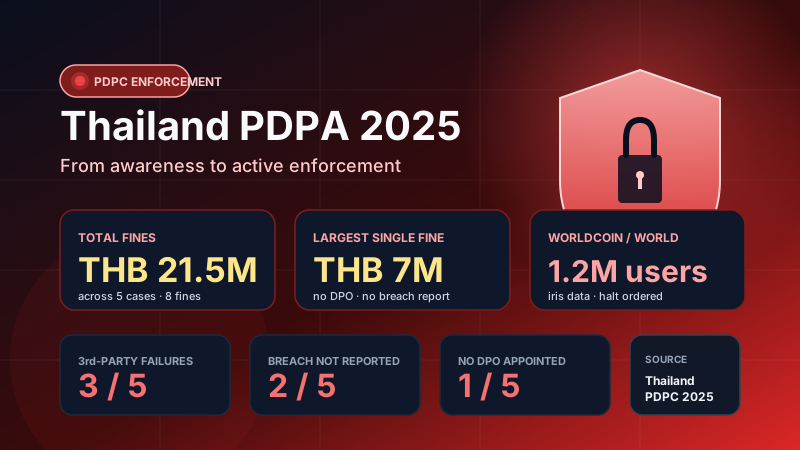
Many organizations still see PDPA (Thailand’s Personal Data Protection Act) as mainly about paperwork and consent forms. In reality, PDPA is a framework that requires organizations to maintain strong cybersecurity.
When personal data is exposed, organizations face more than just the direct impact of an attack. They may also be dealing with:
- PDPA fines of up to THB 5 million
- Civil damages that data subjects can claim through legal action
- Reputational damage that is difficult to measure
IBM reports that the global average cost of a data breach reached USD 4.44 million in 2025 — 9% lower than the previous year because organizations using AI-driven defense tools were able to detect and contain incidents faster.
The Zero Trust Approach: Trust Nothing Until It’s Verified
Zero Trust Architecture is not a product you buy and install — it is a mindset built on the principle: “trust no one, verify everything,” whether the access request comes from inside or outside the organization.
Core principles:
- Verify Explicitly — every access request must be authenticated, whether the user is inside or outside the corporate network
- Least Privilege — grant only the minimum level of access required, no more and no less
- Assume Breach — design systems as if compromise has already happened, and segment environments to limit damage
For mid-sized Thai businesses, adopting Zero Trust does not require replacing everything at once. A practical starting point is:
- Enable Multi-Factor Authentication (MFA) across all systems
- Review employee access rights across the organization
- Segment networks to limit lateral movement of threats
Employees: The First Line of Defense
No matter how strong your technology is, it only takes one employee clicking a phishing link to create a serious incident. Building security awareness across the organization should include:
- Regular training — not just once a year, but every quarter, with content updated to reflect the latest threats
- Realistic simulations — use phishing simulations to measure how prepared teams really are
- A security-first culture — employees should feel comfortable reporting suspicious activity without fear of blame
- Simplicity — if following security policies is too complicated, employees will look for shortcuts
Incident Response: Prepare Before an Attack Happens
The real question is not “Will we be attacked?” but “How quickly can we respond when it happens?”
A strong incident response plan should include:
- A clearly defined response team — who makes decisions, who does what, and who must be contacted first
- Playbooks for each scenario — ransomware, data breaches, and DDoS attacks each require different response steps
- Communication planning — how to notify customers, employees, the media, and regulators
- Regular drills — practice at least twice a year, just like a fire drill
The Cost of Prevention vs. the Cost of Damage
Thailand’s cybersecurity market was valued at USD 484.48 million in 2025 and is expected to grow to USD 894.04 million by 2030. This reflects how much more seriously Thai businesses are beginning to take cybersecurity.
For SMEs and mid-sized businesses, the key point is this:
- The cost of prevention is often 10 to 50 times lower than the cost of a successful attack
- Investing in AI-powered security can significantly reduce detection and containment time — from 280 days to an average of 241 days
- The Thai government designated 2025 as the “Year of Cybersecurity,” and NCSA, together with ISC², aims to train 10,000 professionals by 2026
Key Takeaways
Cyber threats do not discriminate by business size. SMEs and large enterprises alike can become targets. What makes the difference is how prepared the organization is to respond.
Getting started does not require a massive budget — begin with the essentials: MFA, backups, employee training, and an incident response plan. From there, gradually strengthen your security posture based on your organization’s risk profile.
Concerned about cybersecurity? Talk to the Enersys team to assess your organization’s cyber readiness.
References