TL;DR
On 9 June 2026, Anthropic announced Claude Fable 5, which the company describes as "a Mythos-class model that we've made safe for general use."
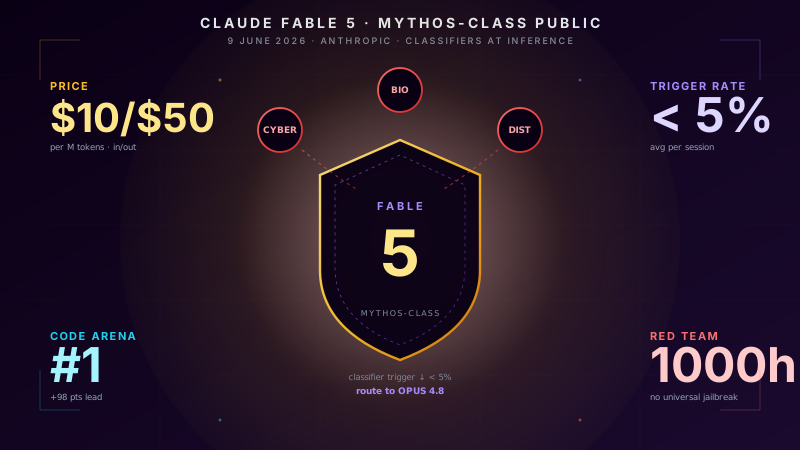
Fable 5 uses the same underlying model as Mythos 5, which Anthropic restricts to Project Glasswing partners and biology researchers. The difference is that Fable 5 carries three classifiers that inspect queries at inference time. When a query touches sensitive territory, namely cybersecurity, biology and chemistry, or distillation (attempts to extract the model), Fable 5 routes the response to Opus 4.8 instead.
Anthropic reports that these classifiers trigger in under 5 percent of sessions on average. The company's red team spent over 1,000 hours and found no universal jailbreak.
Pricing is $10 per million input tokens and $50 per million output tokens, twice Opus 4.8.
On capability, Anthropic reports Fable 5 reaches state-of-the-art results on nearly every benchmark the company measured, particularly in software engineering, knowledge work, vision, and scientific research. The company notes that "the longer and more complex the task, the larger Fable 5's lead over other models."
This piece sets out the news, what Mythos-class means, and what enterprise teams should consider.
A Sequence That Caught Attention in a Few Days
The timeline matters.
In early June 2026, Anthropic issued a statement warning that AI is becoming more dangerous than many people understand. TechCrunch and other outlets cited the warning.
A few days later, on 9 June, Anthropic released Fable 5 publicly. The juxtaposition was read by observers as a deliberate answer to the question of how the company itself deploys frontier capability. The answer was not to hold back at the consumer end. It was to launch the frontier model with safeguards designed for public use.
CNBC and NBC News reported Fable 5 as the public release of technology Anthropic had previously said concerned government regulators. CNBC used the phrase "Mythos-like AI model to the public."
On positioning, Cryptobriefing reported that Fable 5 ranked first in the Code Arena ranking by 98 points. For a developer audience, that signalled a meaningful step up by Anthropic in the coding tier.
Simon Willison, the independent observer who tracks frontier models closely, published an initial impression the same day. The model "performs noticeably better in my tests," he wrote, while asking for more time before drawing final conclusions.
Mythos and Fable: The Difference Is the Classifier, Not the Model
The point that confuses many readers.
Mythos 5 and Fable 5 share the same underlying model. That means the underlying capability is identical. The entire difference lies in safeguard configuration.
Mythos 5 has safeguards "lifted in some areas" for research partners and specific programmes, including Project Glasswing and the biology researcher initiative, so the model can be used on tasks Fable's classifiers would block.
Fable 5 wraps three classifiers around the model to make it safe for general use.
The architecture Anthropic chose puts classifiers as a runtime safety layer, rather than relying on fine-tuning the model weights to filter sensitive topics. The result is that the company can ship a model with full capability while classifiers decide at inference time whether the query is something the model should answer or whether the response should come from Opus 4.8.
This differs from traditional AI safety, which often relies on RLHF during training. Anthropic explains the choice in its report. Classifiers can be updated and re-tuned without retraining the model itself.
The Three Classifiers
Anthropic disclosed the structure.
Cybersecurity classifier. Filters queries about exploitation and offensive cyber tasks. The red team spent over 1,000 hours testing and found no universal jailbreak. That does not make the classifier perfect. Topic-specific jailbreaks remain possible.
Biology and chemistry classifier. Filters queries about sensitive biological or chemical research. Anthropic describes this one as "overly broad by design," meaning it accepts false positives in service of the safety priority. Customers working in these fields may see the classifier trigger more often than average.
Distillation classifier. Filters queries that appear to be attempts to extract the model weights or training data through prompt engineering. This matters in an era where frontier model value is high and distilling outputs of a large model into a small model is an industry technique.
Trigger rate. Anthropic reports that the classifiers in combination activate in less than 5 percent of sessions on average. For typical use, the experience should feel friction-free. Only queries that approach sensitive topics will see the handoff to Opus 4.8.