Quick Take
I'm writing this after watching two friends — one clearly smarter, the other equally hardworking — start their careers four years ago.
Today the smarter one is still a Senior Analyst at a SET100-listed firm, passed over for promotion twice. The other? Head of Product at a company about to raise Series A, with 18 people reporting to him.
The difference wasn't talent. It was something Cambridge, McKinsey, Harvard, and MIT have been quietly documenting for thirty years: proximity to someone genuinely good changes a career faster than anything else we've measured.
But before you fire off resumes to startups — Yale researcher Olav Sorenson published findings in Organization Science showing startup employees earn less over the long run than their corporate counterparts.
So this article has two jobs: show you why hands-on CEO proximity is the career hack Harvard/Stanford/MIT research supports, and show you the trade-offs honestly — because this path is not for everyone.
By the end, you'll choose based on real five-year goals, not FOMO or LinkedIn aesthetics.
Intro: When I Realized "Smart" and "Advancing" Are Different Things
Fresh out of school, I believed smart = advancing. Work hard, learn fast, ship results, get promoted.
Then I watched how corporate careers actually unfold. The smartest people on the team weren't moving up fastest — the ones moving up fastest were the ones who worked closest to whoever made decisions.
And the people who jumped levels in 18 months instead of 5-7 years? They worked next to a founder or CEO who was hands-on every day.
I thought it was luck. Then I read the research. It's not luck — it's a mechanism researchers around the world have documented for decades. The seven lessons that follow come from real academic research, not opinion.
Lesson 1: Apprenticeship Is Older Than the MBA — and Still Works Better
McKinsey recently published "Reviving the Art of Apprenticeship to Unlock Continuous Skill Development."
Their definition is precise:
"Apprenticeship is a relationship-driven learning model, based on actual day-to-day work, in which a novice gains hands-on knowledge from an expert to grow skills and act with increasing independence."
In plain English: you learn faster by being physically near an expert and doing real work every day — not by sitting in a classroom.
The data is striking. McKinsey cites studies showing year-2 apprentices reach 70-75% of the productivity of fully-trained employees.
Compare that to an MBA — same two years, but you still need 6-12 months of on-the-job learning afterward.
Why are apprentices faster? McKinsey's answer: "In the classic one-on-one model, learning happens as a result of physical proximity and observation."
This is why goldsmiths, Michelin-starred chefs, and luthiers still use apprenticeship. It works.
In knowledge work, getting to work next to a hands-on CEO is apprenticeship 2026. You watch:
- 100 decisions a week being made in real time (not summarized later)
- Reasoning that sometimes contradicts what looks logical on paper
- The moment a founder hesitates and chooses
- The moment a founder is wrong and admits it
No book teaches this. You have to be in the room.
Lesson 2: 75% of Executives Say "Mentorship Is Why I Got Here"
Harvard Business Review cites a stat from the American Society for Training and Development:
75% of executives say mentoring played a critical role in their career development.
Read it again. Not "helpful." Not "nice." Critical.
HBR also reports research showing new employees who received on-the-job advice from experienced people outperformed non-mentored workers by 18% — and stayed longer with the company. 18% sounds modest. Compounded over 5 years, that's 2.3x the impact.
Now ask yourself — who's the better mentor? (A) A middle manager at a large company with 8 reports and their own KPIs to hit. (B) A hands-on founder/CEO with 4-6 direct reports and skin in the game across the entire business.
It's not about title. It's about time, attention, and stake they'll invest in you. A hands-on founder has much higher stake — if you grow, the company grows. They benefit directly. A corporate manager? Sometimes a too-good direct report becomes a threat. We all know this is true even when nobody says it.
Lesson 3: Your Developmental Network Matters More Than Any Single Skill
Professor Monica Higgins at Harvard Graduate School of Education started a research project in 1996 called "Building Career Foundations."
She tracked 136 Harvard MBA Class of 1996 graduates for 30 years and measured how the quality of each person's developmental network predicted career outcomes.
The results (published across dozens of academic papers) show network quality directly predicts:
- Work satisfaction
- Organizational commitment
- Intentions to stay
- Promotion outcomes
- Professional identity
- Career-related self-efficacy
In short: who you know matters more than what you know.
But here's what most people miss — networks don't come from networking events. Real networks come from people you've worked with closely enough that they trust you enough to recommend you.
This is why working close to a hands-on CEO changes the math: your network = their network.
A hands-on CEO knows investors, other founders, C-suite at partner companies, tech press, domain experts. In two years working with them, you'll know these people too — not as "LinkedIn requests" but as people the CEO has personally vouched for.
In big corp, accessing this tier takes 10-15 years.
Lesson 4: "Operating in Ambiguity" — A Skill Stanford Teaches Only 12 Students Per Year
Stanford Technology Ventures Program runs a quiet little program called the Mayfield Fellows Program.
From thousands of Stanford undergrads each year, they pick only 12. Stanford describes the goal directly:
"to operate in ambiguity, rigorously chosen for initiative, leadership, and the ability to deliver real impact inside fast-moving organizations"
Operating in ambiguity = working in conditions where there's no right answer, no clear process, no playbook.
This is the #1 skill separating founders and senior operators from everyone else — and Stanford invests in selecting just 12 people a year to teach it.
Here's the punchline: you can learn this skill for free if you work with a hands-on CEO.
Why? Because every day there is ambiguity:
- Will the customer say yes or no?
- Is this price too high or too low?
- Should we expand now or wait?
- The system crashed — quick fix or rebuild?
There is no right answer. You decide with incomplete information.
In big corp, processes, committees, and SOPs insulate employees from ambiguity. In a hands-on company, you swim in it daily.
The first six months are uncomfortable. After that, your brain rewires. This is the skill that makes future CEOs, not lifelong middle managers.
Lesson 5: Decision Speed — Something Corporate Will Never Teach You
Let's count.
At a SET100-style large firm: strategy session 1/quarter, ~4 major decisions per year you observe end-to-end, decision-maker is 4-5 layers above you, outcomes take 6-12 months to surface.
At a hands-on founder's company: 5-10 major decisions per week, in the room, full context (not summaries), outcomes in 1-4 weeks, you participate in some (not just observe).
Side by side:
| Path |
Decisions you'll learn from in 2 years |
| Corporate |
~ 8-15 |
| Hands-on CEO |
~ 500-1,000 |
That's a 50-100x difference.
This is why MIT Sloan published research showing employees with regular career development discussions are 3.5x more likely to feel engaged at work.
Decision-making is muscle memory. In corporate you rep once a month. At a hands-on company you rep five times a day. After 18 months, you make sharper business calls than a corporate manager who's been doing it for 7 years — not because you're smarter, but because you've repped many more times.
Lesson 6: You'll Start Thinking Like an Owner, Not an Employee
There's a quiet shift that happens after a few months working close to a hands-on founder.
At first, you think like an employee:
- "How do I hit my KPI?"
- "How do I impress my boss?"
- "How do I avoid mistakes?"
After six months, you start thinking like an owner:
- "How does this decision affect cash flow?"
- "Is this customer worth the time we'd invest?"
- "If we choose option A, what opportunity cost are we eating?"
- "Why does the obvious decision sometimes not get made?"
That last question is the most important — because it opens a new world. You start seeing every decision through layers:
- Timing (right now, wrong in 3 months)
- Politics (this person agrees, that one doesn't)
- Resources (we have the budget, not the people)
- Context (how will the customer react)
In corporate, you only see the outcome — never the reasoning. In a hands-on company, you see all of it.
After two years, you have executive judgment — the thing that takes most people 15-20 years to develop. This is the skill that lets you become a CEO later.
Lesson 7: But the Research Has a Dark Side You Need to Know
If I stopped here, this would be marketing for startup life. I won't.
The research has a darker side most people skip.
Olav Sorenson (now at UCLA Anderson, formerly Yale School of Management) published findings in Organization Science that shook the field:
"Startup employees earn LESS over the long run than counterparts at established firms."
Sorenson also documented "career path dependency" — once in startups, employees tend to stay in small firms even when changing jobs, with less stability and longer unemployment spells.
Translation — if you spend 5 years in startups and want back into corporate? It's harder than you think.
Big-company HR may see you as "not fitting our process" or "no experience in structured environments."
And from Wharton (Mack Institute): startup employees are 77% more likely to quit when firm-initiated. That's a brutal number — startup employees quit more, get laid off more, and the companies fold more often.
On top of that:
- No real pension
- Benefits typically weaker than corporate
- Health insurance often basic
- Bonuses unreliable
- Equity (options) usually worth nothing
The dark side, summarized: working with a hands-on CEO is fast — and risky.
If reading this scares you, good. Fear means you understand the trade-off. If you read it and still feel pulled — keep going to see if you fit.
Who This Path Is For
After reading the research, here's the profile:
- People who want to be a founder/CEO in 3-5 years — this is an accelerated practical MBA. The skills you'll get can't be taught in a classroom.
- People who handle uncertainty well — every day is unknown. Plans change. Priorities shift. If you need stability to perform, this will drain you.
- People who learn fast and execute fast — there is no 6-month onboarding. You need to be productive in 4-6 weeks.
- People with no ego problem — the CEO gives feedback raw, sometimes blunt. If "do this better" feels like a personal attack, you'll be miserable.
- People with 12-24 months of financial runway — if the company dies, you need money to survive 1-2 years. Don't take on a big mortgage or have a baby right before joining.
Who Should Stay Away
If you're in this group, joining a hands-on CEO will hurt.
- People needing stability for family — two kids, a mortgage, aging parents — corporate predictability is the right move.
- People for whom pension/benefits/insurance matter most — if safety is your top priority, startup life will keep you up at night.
- Narrow specialists (lawyers, doctors, actuaries, pilots, etc.) — careers built on credentialing in regulated systems — startup is not your path.
- People near retirement (55+) — ROI on learning new skills doesn't justify the financial risk.
- People who want a "bench warming" career — there is no bench here. Anyone not contributing exits.
How to Find a Good Hands-On CEO — 5 Signs to Look For
Not every founder is a good hands-on CEO. Some are exhausted. Some have huge egos. Some just want cheap labor. Five signs the founder is worth your time:
- The CEO answers their own email/Line/Slack — not through an assistant. Serious CEOs don't hide. They reply themselves. If every message routes through an assistant, they've already detached.
- The CEO codes/sells/builds something hands-on at least once a week. If they don't actually do anything anymore, they're a manager, not a founder. You won't learn from watching them present slides.
- The CEO asks more questions than they give orders. A great one asks "What do you think?" A dangerous one commands "Do it this way." In your interview, count questions vs. commands.
- The CEO admits what they don't know. A founder who says "I need someone better than me in this area" is safe. One who acts like they know everything — careful.
- The CEO has people on the team who are better than them. Check the LinkedIn of current employees. If you see profiles stronger than the CEO's in their domain — good (small ego). If not — careful (likely an ego problem).
Three Questions to Ask Yourself Before Deciding
Before hitting "submit" on that application — sit for 30 minutes.
1. Are you ready to learn faster than you ever have in your life? In corporate, you learn one new skill per quarter. In startup, one per week. If you're not willing to keep your brain open every day, read every night, and pick up a new skill monthly — don't come.
2. Are you OK earning 20-30% less than big corp to trade for experience? An honest startup won't match a big-corp salary at the equivalent level. What you get instead: 3-5x learning speed, hundreds of meaningful decisions, possible equity upside (never plan your life on equity). If next month's salary is the most important thing in your life right now — don't come.
3. Can you take direct feedback? Imagine the CEO says in a meeting, "You're wrong on this. Redo it." If that makes you want to cry or fight — you'll be miserable here. If you can say "OK, got it" and not carry it home — you fit.
How We Think About This at Enersys
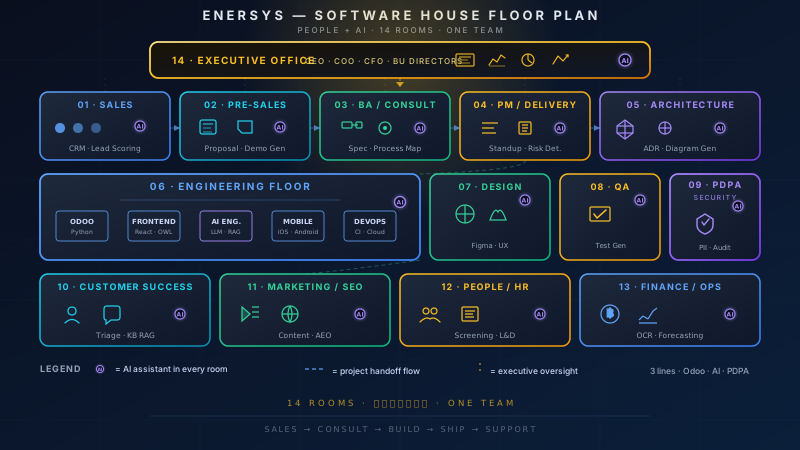
Enersys is a software house — we focus on Odoo ERP, Enterprise AI, and Data Privacy (PDPA). Our founders and tech leads are hands-on every single day, not sitting in offices reviewing reports.
We don't pretend to match big-corp salaries. We don't. What we offer is a different ROI: you'll work next to people making real decisions, see the P&L of projects you ship, talk to customers directly (not through three layers of account managers), and learn Odoo / AI / PDPA from hands-on practitioners — not trainers who've never built anything.
If you're at the right life stage, this is the fastest growth path we know. If not, we get it. The corporate path is just as valid.
Closing — Choose by Your Real Goals, Not by Trend
I won't tell you which path is better. The answer isn't "better" — it's "right for your goal."
Corporate path is right if you want stability for family, a specialist career requiring credentials, predictable financial ROI, or a network within a specific industry.
Hands-on CEO path is right if you want to be a founder/CEO in 5-10 years, accelerated learning, a network across founders/investors/operators, and the skill of "operating in ambiguity."
Don't choose by trend. Don't choose because your friends did. Don't choose because it looks cool on LinkedIn.
Choose because you understand the trade-off and your five-year goal aligns with this path. Harvard, Stanford, MIT, and Cambridge research supports the upside. Yale and Wharton research warns of the limits. We listen to both.
The decision is yours. But make it with information, not emotion.
Sources
Every claim above traces back to a verified source:
If you're choosing a career path — read the originals before you decide. Not just summaries.
It's your life. Your call.