“A slow-loading website” is not a technical problem — it is a business problem
Imagine this: a customer searches for your service on Google, finds your website, clicks through... and waits.
1 second... 2 seconds... 3 seconds...
According to Google, there is a 53% chance that customer will leave the page immediately without ever seeing a single one of your products or services.
This is not a hypothetical number. It is based on real user behavior collected by Google from millions of users. And for Thai businesses — where 97% of internet users access websites via mobile — the problem is even more serious than many realize.
The numbers Thai businesses need to know
Every extra 1 second of delay = lost revenue
Here is what global companies that have seriously studied this issue have found:
- Amazon found that every additional 100 milliseconds of load time reduced sales by 1%
- Walmart found that improving website speed by 1 second increased conversions by 2% and revenue per visitor by as much as 48%
- Google and Deloitte studied 37 retail websites and found that websites that became just 0.1 seconds faster saw conversion increases of 8.4% for general retail and 10.1% for luxury goods
Bounce rate rises with load time
From Google and SOASTA research:
| Load time increases from 1 second to |
Increase in bounce probability |
| 3 seconds |
+32% |
| 5 seconds |
+90% |
| 6 seconds |
+106% |
| 10 seconds |
+123% |
Simply put, if your website loads in 5 seconds instead of 1 second, you are losing nearly 2x more visitors before they even see your content.
Why this matters especially for Thai businesses
1. 97% of Thai users access websites on mobile
According to DataReportal Digital 2024, Thailand has around 69.5 million internet users, and 97% access the internet via mobile — one of the highest rates in the region.
But here is the reality many overlook: even though Thailand has high mobile internet speeds in urban areas, most users still use mid-range smartphones — Samsung Galaxy A-series, Redmi, OPPO — which process web content 40–60% slower than flagship devices.
That means a site that feels fast on an iPhone 15 Pro may load much more slowly on the phones most Thai users actually use.
2. Google uses website speed as a ranking factor
Since 2021, Google has officially used Core Web Vitals as a search ranking factor. It consists of 3 key metrics:
- LCP (Largest Contentful Paint) — how quickly the main content appears
- INP (Interaction to Next Paint) — how quickly the page responds to clicks
- CLS (Cumulative Layout Shift) — how much the page layout shifts unexpectedly
According to Google, pages that pass Core Web Vitals are 24% less likely to be abandoned compared with pages that do not.
3. First impressions are everything
79% of online shoppers who are dissatisfied with website speed say they will not return to buy from that site again, and 44% will tell friends about the poor experience.
In an era where word of mouth spreads through social media, a slow website does not just lose one customer — it may lose that customer’s entire network.
A real case: when a website we manage scored 60
We are not speaking from theory alone — our team encountered this issue on a website we manage ourselves.
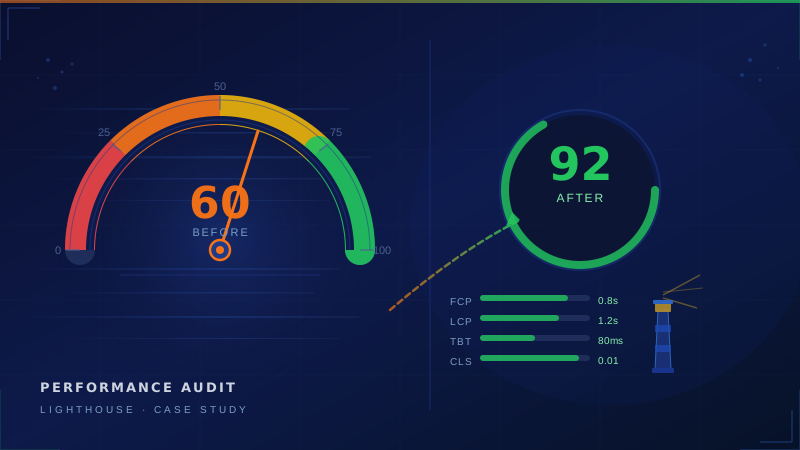
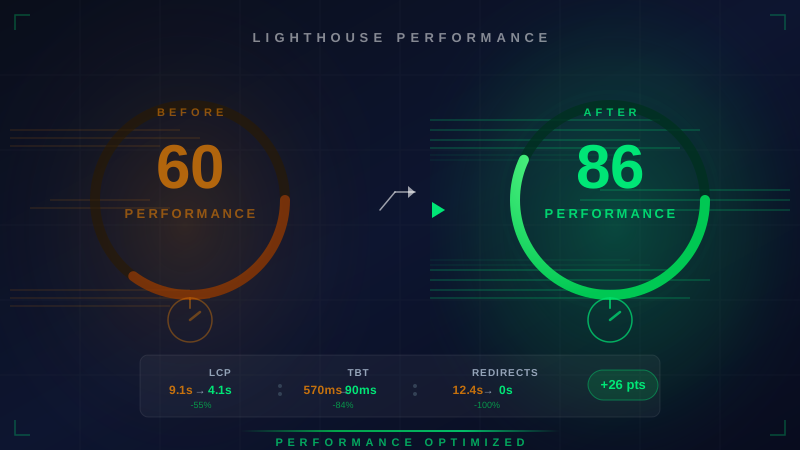
When we evaluated the site using Google’s standard performance tools, the result was 60 out of 100. The page took 9.1 seconds to load its main content, and a hidden redirect chain was consuming 12.4 seconds
What was most surprising was that no one on the team knew there was a problem. The site looked normal, worked fine, and showed no errors — but customers visiting on mobile had to wait far longer than they were willing to tolerate.
Our approach
Instead of guessing at fixes, we followed a root-cause-first approach:
- Measure — Use standard tools to score performance and identify problem areas
- Analyze — Determine the actual causes and prioritize them by impact
- Fix — Resolve issues one by one, starting with the highest-impact items
- Measure again — Confirm that the fixes produced real results without creating new problems
Results
| Metric |
Before |
After |
Change |
| Overall score |
60 |
88 |
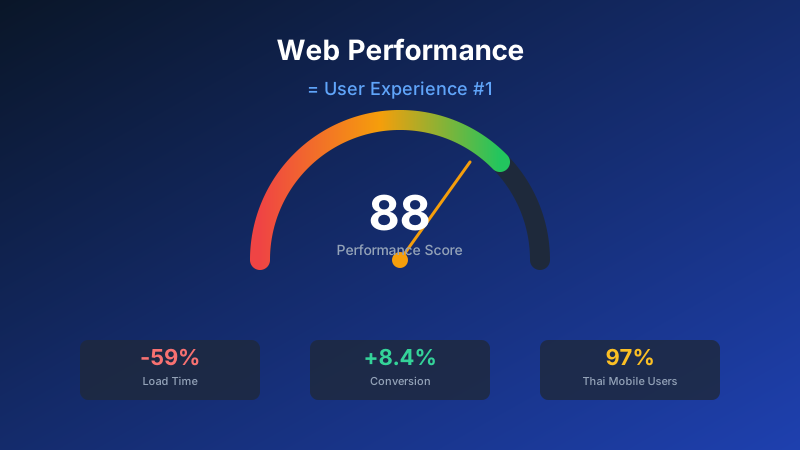
+28 points |
| Main content load time |
9.1 seconds |
3.7 seconds |
-59% |
| Unresponsive time |
570 milliseconds |
90 milliseconds |
-84% |
| Layout shifting |
Present |
Almost none |
Resolved |
From 60 to 88 within 1 hour — because we addressed the right issues from the start.
5 signs your website is losing customers
If your business matches any of the points below, it is time to take Web Performance seriously:
1. Unusually high bounce rate
If your bounce rate is above 50–60%, especially on mobile, your website may simply be too slow for real users. It is not necessarily that your content is unappealing — they may never have seen it.
2. You have never measured Core Web Vitals
If you do not know the current status of your LCP, INP, and CLS, you may be losing both Google rankings and customers without realizing it.
3. Your website was built more than 2 years ago and has never been optimized
Web technology changes quickly. A website that was fast 2 years ago may already be slow by today’s standards — especially compared with competitors that continuously improve.
4. Low conversion rate despite high traffic
If plenty of people visit your website but do very little (no form submissions, no inquiries, no purchases), the issue may not be your product or pricing — it may be a slow user experience that causes people to give up.
5. No performance monitoring
Your website is your digital storefront. If you have CCTV for your physical store but never check how well your online storefront performs, you may be missing business opportunities every day.
Why performance is the #1 priority in UX
Many people think User Experience means beautiful colors, attractive buttons, or stylish animations. But the truth is:
The best UX is UX that does not make users wait
A beautifully designed website that takes 5 seconds to load is like a luxury storefront with the door locked for 5 seconds before customers can enter — most people will simply walk to the shop next door.
From our experience managing corporate websites in Thailand, the real UX priority order that affects conversions is:
- Speed — users must see content within 2.5 seconds
- Stability — the page must not jump around, break, or show errors
- Simplicity — users should be able to complete what they need within 3 clicks
- Visual design — build trust and create a strong impression
Notice that speed always comes before visual design — because if the website does not load in time, users will never see the beautiful design you invested in.
What you can do today
No matter what industry your business is in, the first thing you should do is measure — know where your website stands before anything else.
Google offers free tools that score your website against Core Web Vitals standards. It takes less than 1 minute, but the result may completely change how you view your own website.
And if the score is disappointing — that is an opportunity. Every point you improve can mean better conversions, longer engagement, and more revenue.
Ready to find out where your website stands?
The Enersys team has experience analyzing and improving Web Performance for Thai organizations — backed by real-world work and measurable results.
Consult with us for free to receive a performance analysis of your website, along with a clear improvement plan designed to deliver visible results.