The $4 Million That Almost Disappeared — Without Anyone Noticing
Imagine you’re managing a high-precision electronics parts factory. The production line is running normally. KPIs are green. Customers aren’t complaining. Everything appears to be “fine.”
But beneath that surface-level normalcy, 13 critical issues are quietly hiding — problems invisible to the human eye, absent from daily reports, and only weeks away from turning into nearly $4 million in total losses.
This isn’t a hypothetical scenario. It actually happened to Fabrinet, one of the world’s major manufacturers of optical and electronic components, with a significant production base in Thailand.
And what saved them wasn’t better experts, stricter inspections, or more manual checks. It was a system that connected machine data, quality data, and business data together — then let AI do what humans cannot: detect patterns across systems in real time.
Fabrinet Case Study — 13 Problems Humans Never Saw
Fabrinet is not an ordinary factory. The company produces highly precise components for telecommunications and advanced technology industries, which means even small production errors can lead to enormous financial impact.
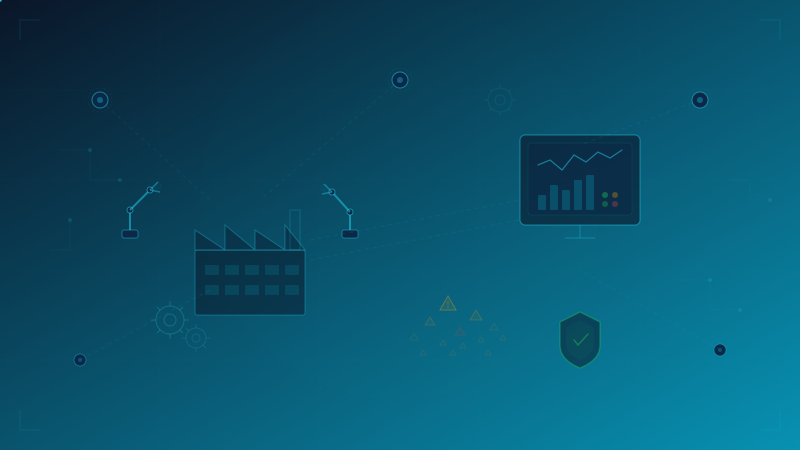
What Fabrinet did was integrate its defect monitoring system with ERP and MES through a single central platform. Instead of letting each system operate separately and sending reports for people to review manually, everything was connected so the organization could actually “see” abnormalities happening across processes.
The results in the first year:
- The system detected 13 critical issues that traditional inspection processes had never caught
- Nearly $4 million in avoidable losses were prevented — including scrap, product recalls, and line stoppages
- These issues were identified at an early stage, before they escalated into major disruptions
What makes this case so interesting is not just the number, but the nature of the problems discovered. Many of them came from interactions between processes. For example, one raw material lot passed QC according to spec, but when used under specific production conditions, it caused yield to drop in the next stage. This is exactly the kind of issue humans struggle to connect — because the data sits in different systems, departments, and reports.
The key lesson: The most expensive problems in a factory are not the ones you can see — they’re the ones you don’t even know exist.
The “Detroit of Asia” Is Evolving — And the 40% Number Proves It
Thailand has long been called the “Detroit of Asia” because manufacturing is one of the pillars of its economy. But what’s changing quietly is this: Thailand’s industrial base is no longer standing still.
Here are the numbers that matter:
- More than 40% of large Thai manufacturers have adopted at least one Industry 4.0 technology
- 40% of Thai SMEs have started using AI to improve competitiveness
- 65% of manufacturers globally are expected to use AI and IoT for predictive maintenance by 2027
- Thailand’s ERP software market continues to grow, reflecting rising demand for stronger back-office systems
The government’s Thailand 4.0 policy has been an important driver. But even more interesting is that the private sector has started moving on its own. Companies are no longer waiting for policy direction, because pressure from costs, labor constraints, and foreign competitors has made “doing things the old way” no longer a viable option.
Events like the Manufacturing IT Summit Thailand 2026 show that Thailand’s manufacturing technology ecosystem is maturing in a serious way. It’s not just another vendor conference — it’s becoming a space where Thai manufacturers exchange real-world experience.
AI + ERP + IoT — Three Forces That Must Work Together
This is where many factories get it wrong: they buy technology one piece at a time.
They install IoT sensors and suddenly have a flood of machine data, but don’t know what to do with it. They buy an ERP system and improve inventory and finance, but production data remains disconnected. They experiment with AI and enjoy the demo, but in real operations, the data isn’t good enough for the models to learn from.
The truth people rarely say out loud is this: AI, ERP, and IoT deliver the best results when they work together, not separately.
Think of it this way:
- IoT is the factory’s “nervous system” — collecting real-time data from machines, temperature, vibration, RPM, and more
- ERP is the factory’s “memory” — storing raw materials, cost, purchase orders, production schedules, and historical records
- AI is the “brain” that connects both — analyzing patterns across datasets, predicting problems early, and recommending decisions
The Fabrinet case above is one of the clearest examples. A defect detection system alone might catch part of the problem. But once it was connected with ERP data — such as raw material lots, suppliers, and production conditions — the system could detect much more complex patterns.
Today, cloud-based industrial data platforms can combine machine data, ERP data, and production KPIs seamlessly. That means connecting these three layers no longer requires factories to build everything from scratch themselves.