Good business systems do not start with features
When companies discuss ERP, Odoo, or AI, the first conversation is usually about features: approval flows, dashboards, accounting sync, AI assistants, inventory reports, or document automation.
Those questions matter, but they are not the foundation of a reliable business system.
The better question comes earlier: if this system becomes part of the daily operating core of the company, can it keep working as users, data, integrations, and business complexity grow?
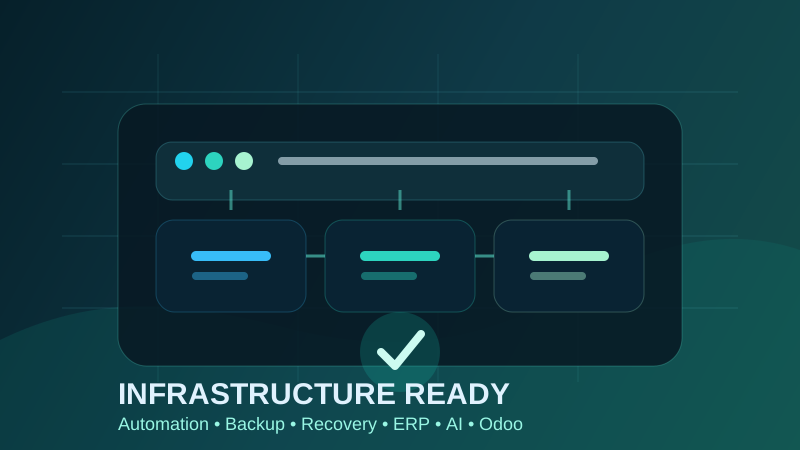
At Enersys, we see ERP, Odoo, and AI projects as infrastructure-dependent from day one. The system should not merely work during the first demo. It should be prepared for production usage, operational change, backup, recovery, monitoring, and future expansion.
Once a system is live, the real risks become practical:
- Can deployment happen without disrupting daily work?
- Can backup data actually be restored?
- Are production, staging, and testing environments clearly separated?
- Does the system warn the team before a small problem becomes a business incident?
- Is business data protected, governed, and auditable?
That is why infrastructure, automation, and backup planning are part of the foundation, not an afterthought.
Infrastructure is not just servers
Many organizations still think of infrastructure as servers, CPU, RAM, databases, and storage. For modern business systems, infrastructure is the operating layer that keeps business processes alive.
If ERP is the nervous system of the company, infrastructure is the circulation that keeps every part working together.
For Odoo and ERP projects, strong infrastructure must support five concerns.
First, production stability. ERP touches sales, purchasing, inventory, accounting, HR, and approvals. People rely on it every day.
Second, data protection. ERP contains customer records, supplier data, invoices, payroll, margins, and transaction history.
Third, safe testing. Workflow changes, module additions, and upgrades should be tested outside production.
Fourth, recovery. Mistakes happen: human error, migration issues, integration failures, and external dependency problems.
Fifth, scale. A system that is fine today may need to handle far more users, records, and integrations within a year.
Odoo.sh reflects this same direction by combining GitHub workflows, staging environments, continuous integration, and automated backups. Modern ERP infrastructure is part of the product experience, not a detached back-office concern.
Automation makes quality repeatable
Manual operations can feel flexible at first. As systems grow, they become a source of cost and risk.
Common warning signs include:
- deployments that depend on long manual checklists
- backups that rely on someone remembering to run them
- database copies handled by a single person
- configuration changes repeated by hand across environments
- production knowledge concentrated in one or two people
These may not fail in the first month. They tend to fail when there are more projects, modules, integrations, and stakeholders.
Good automation makes critical work repeatable:
- build and deployment steps become auditable
- new environments can be created consistently
- backups follow a designed schedule
- monitoring and alerts work without manual inspection
- rollback and recovery paths can be tested
For ERP and AI, repeatability matters because the work does not end at go-live. Business processes change, reports evolve, users ask for improvements, and the system has to keep moving without losing stability.
Backup only matters if recovery works
The word backup can create false confidence.
Having backup files does not mean the business can recover. A reliable backup strategy must answer how quickly the system can return and how much data loss the business can tolerate.
AWS Well-Architected describes these objectives as RTO and RPO:
- RTO: how long the business can tolerate the system being unavailable
- RPO: how much historical data loss the business can tolerate
Without those answers, backup planning is incomplete.
A strong ERP/Odoo backup model should clarify:
- whether backups include both the database and file attachments
- where backups are stored relative to production
- how often restore tests are performed
- who can perform restore actions and what approvals are required
- whether restored test environments are neutralized so they do not send duplicate emails, payments, or external actions
Odoo.sh gives a useful reference model: production databases are automatically backed up daily, with daily, weekly, and monthly retention. Staging and development databases can be restored from production backups for testing without affecting live work.
At Enersys, we treat backup as part of the operating model, not as a file kept somewhere for a hypothetical emergency.
ERP, Odoo, and AI need different foundations but the same discipline
ERP and Odoo need accurate, continuous, auditable data. AI needs trustworthy, permission-aware, governed data.
They look different on the surface, but strong infrastructure supports both through the same discipline.
For ERP and Odoo
The system needs reliability, access control, auditability, backup, migration discipline, and staging environments that are close enough to production for real testing.
Every change can affect accounting, stock, approvals, and management reporting.
For AI
The system needs data pipelines, permission boundaries, monitoring, usage controls, logging, and clear separation between production data and test data.
Good AI is not only about better answers. It is about using real business data without creating new operational or privacy risk.
For ERP plus AI
This is where infrastructure matters most. AI starts touching business data such as sales history, inventory movement, customer profiles, invoices, tickets, and internal documents.
If the foundation is weak, AI remains a polished feature with limited production value.
If the foundation is strong, AI becomes a practical layer that makes ERP more useful: summarizing reports, answering internal questions, recommending next actions, and detecting patterns teams may otherwise miss.
What Enersys prepares for customers
We do not see ERP, Odoo, and AI projects as installation work. We see them as operating foundations for the business.
In customer projects, Enersys focuses on:
- appropriate separation of production, staging, and testing environments
- deployment processes that reduce human error
- backup and recovery planning before go-live
- monitoring and alerts for business-critical workloads
- data governance for safe ERP and AI usage
- testing change before it reaches production
- alignment with executives and operations teams on business continuity
The customer does not need every internal implementation detail. What matters is confidence: when the system becomes part of daily work, it has a foundation that can support growth.
Signs your business should revisit infrastructure
It may be time to take infrastructure seriously if:
- ERP or accounting performance slows as data grows
- backups exist but nobody has tested restore
- there is no staging environment for real workflow testing
- every deployment requires after-hours coordination and hope
- integrations between ERP, website, payment, inventory, or CRM are becoming fragile
- the team wants AI but is unsure whether internal data is ready or safe
- critical system knowledge depends on a few people
These issues should not wait for an incident. Once ERP or AI enters core operations, one outage can affect sales, finance, trust, and the daily work of the whole organization.
Key Takeaways
Strong ERP, Odoo, and AI systems are not defined by feature count alone. They are defined by whether the business can depend on them.
Infrastructure readiness gives the organization safer deployment, tested recovery, controlled change, better monitoring, and a stronger data foundation for AI.
This is the foundation Enersys builds with customers: systems that are not only usable on launch day, but dependable as the business grows.
If your organization is planning ERP, Odoo, or AI and wants the system to become a long-term foundation rather than another project that needs rebuilding next year, talk to Enersys.
References